PetNivo Tech Sourcing & Product Team | Produktbeschaffung & Produktentwicklung | Veröffentlicht im September 2026
Die unten aufgeführten Preise entsprechen den öffentlich gelisteten Richtwerten zum Zeitpunkt der Veröffentlichung. Großhandelsangebote ändern sich je nach Menge, Individualisierung und Versandbedingungen. Betrachten Sie daher alle hier genannten Zahlen als Ausgangspunkt für eine Angebotsanfrage und nicht als Festpreise.
Silikon Schleckmatten werden auf der Beschaffungsseite derzeit mit ungefähr $1,35 bis $2,80 pro Stück gelistet, wodurch sie zu den günstigsten Zusatzprodukten gehören, die ein Heimtierhändler neben einem Slow-Feeder-Napf anbieten kann. Dieser Leitfaden behandelt Preise, Überlegungen zur Materialauswahl, Individualisierungsoptionen und die Aspekte, bei denen Käufer die Mindestbestellmengen typischerweise falsch einschätzen.
Was eine Schleckmatte eigentlich ist (und warum sie neben Slow-Feedern angeboten wird)
Eine Leckmatte ist eine flexible Oberfläche aus Silikon, die meist mit Rillen, Saugnäpfen oder erhabenen Mustern strukturiert ist. Sie wurde dafür entwickelt, dass Futter (Erdnussbutter, Nassfutter, Püree) darauf verteilt wird, damit ein Hund oder eine Katze es langsam ablecken kann. Das funktioniert anders als bei einem Slow-Feeder-Napf: Ein Napf verwendet Labyrinthwände oder einen rollenden Ball, um hastige Bissen von Trockenfutter physisch zu bremsen, während eine Matte auf Oberflächenstruktur und Lecken statt auf Kauen setzt.
Einzelhändler platzieren die beiden Produkte zunehmend nebeneinander, weil sie verwandte, aber nicht identische Probleme lösen. Ein Slow-Feeder-Napf wirkt der Geschwindigkeit beim Fressen entgegen. Eine Leckmatte dient der Beschäftigung über einen längeren Zeitraum – bei der Fellpflege, beim Baden, beim Tierarztbesuch oder bei allgemeiner Angst –, weshalb sie eher an der Kasse und in Impulskauf-Platzierungen auftaucht als ausschließlich im Bereich für Futternäpfe.
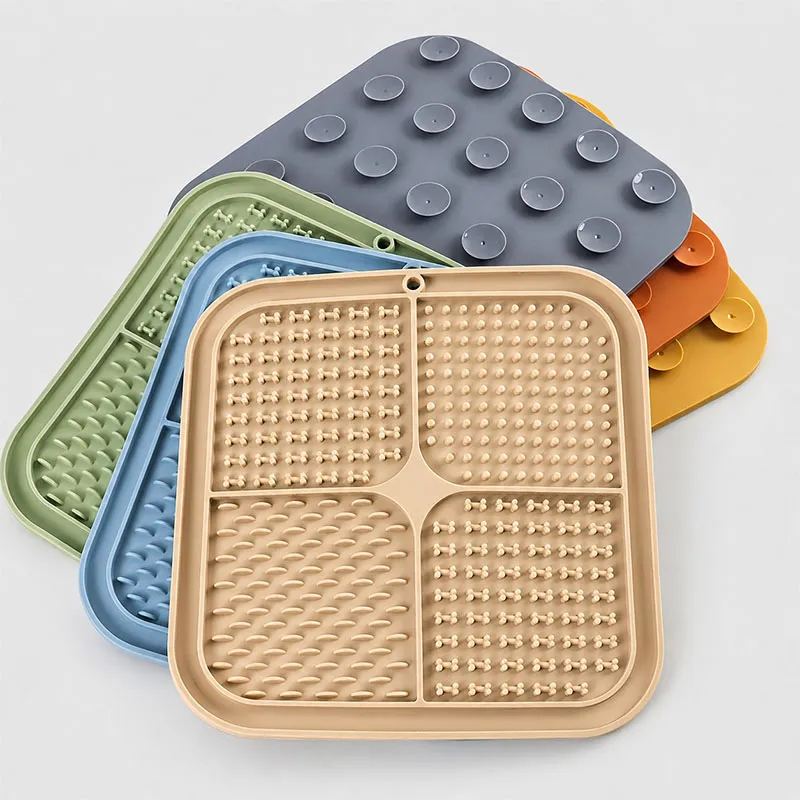
Leckmatte, Slow-Feeder-Napf oder einfache Silikonmatte: So teilt sich die Produktkategorie auf
Im Vergleich zu den Standard-Kunststoffnäpfen, die üblicherweise in allgemeinen Tierbedarfsgeschäften verkauft werden, verfügen sowohl Schleckmatten als auch Anti-Schling-Näpfe über einen speziellen Mechanismus, den der einfache Napf nicht besitzt – weshalb sie gegenüber unbedrucktem Kunststoff auch einen Preisaufschlag haben.
| Attribut |
Silikon-Schleckmatte |
Schlecknapf mit rollendem Ball |
Standard-Kunststoffnapf |
| Website-Referenzpreis (Großhandel, pro Stück) |
$1,35–$2,80 |
$2,50–$3,50 |
Nicht Teil dieser Produktlinie |
| Primärer Mechanismus |
Flache oder strukturierte Oberfläche; das Futter wird in die Rillen gedrückt |
Napf mit einem rotierenden Ball; das Futter haftet am Ball, während das Haustier ihn mit der Nase anstupst oder ableckt |
Offene Oberfläche, kein Mechanismus zur Verlangsamung des Fressens |
| Am besten geeignet |
Um ein Haustier während der Fellpflege, des Badens oder bei Trennungsangst zu beschäftigen |
Um Hunde zu bremsen, die ihr Trockenfutter beim Fressen hastig verschlingen |
Nur zur Standardfütterung |
| Angabe zur Spülmaschinenfestigkeit |
Auf öffentlich zugänglichen Produktseiten nicht angegeben – vor der Aufnahme in einen Beileger der Verkaufsverpackung bestätigen |
Auf öffentlich zugänglichen Produktseiten nicht angegeben |
Nicht zutreffend |
| Mindestbestellmenge im Großhandel |
Für diesen Artikel auf öffentlichen Seiten nicht separat aufgeführt |
Für diesen Artikel auf öffentlichen Seiten nicht separat aufgeführt |
Nicht zutreffend |
Die Lücke in den Zeilen zur Mindestbestellmenge und Spülmaschinenfestigkeit ist in dieser Tabelle kein Versehen – sie entspricht dem tatsächlichen Stand der öffentlich verfügbaren Produktdaten und sollte einem Lieferanten mitgeteilt werden, bevor der Artikel auf einer Produktseite erscheint.
$1,35 bis $3,50: So sehen die Großhandelspreise derzeit aus
| Produkt |
Referenzpreis auf der Website |
| Silikon-Schleckmatte für Hunde |
US$1.35–$2.80 |
| Schlecknapf / Slow-Feeder-Napf für Hunde mit rollendem Ball |
US$2.50–$3.50 |
At a $1.35–$2.80 landed cost band, a Leckmatte sits well inside impulse-buy retail pricing once markup, freight, and packaging are added — which is the main reason buyers use it as a cart-add rather than a destination purchase. The trade-off is that per-unit margin dollars are small; volume, not markup percentage, is what makes the line worth carrying. A buyer stocking a single SKU at low volume will likely find the freight-per-unit cost erodes more of the margin than it would on a higher-ticket item like a $550–$700 treadmill, where freight is a smaller share of landed cost.
Neither price band above includes logo printing, custom color-matching, or retail packaging — those are quoted separately and depend on the customization level chosen.
Is Food-Grade Silicone Actually Safe for Daily Licking?
Silicone is the standard material for this category, and it’s worth being precise about what “food-grade” does and doesn’t mean here. In the United States, the FDA’s food-contact substance framework explains that materials intended to touch food may require authorization through a food-contact notification or an applicable food-additive regulation — food-grade silicone falls under this general framework, not a single blanket certificate. For products sold into the EU, Regulation (EC) No 1935/2004 sets the equivalent requirement for materials and articles that contact food.
None of this means a specific lick mat SKU carries a disclosed FDA or ISO certificate number — it doesn’t, based on currently public product-page information. A retailer building a product listing should ask the supplier directly for the applicable food-contact documentation for that specific mold and batch rather than assuming “silicone” alone satisfies the claim. Writing “FDA Certified” on a listing without that document in hand is a labeling risk, not a marketing shortcut.
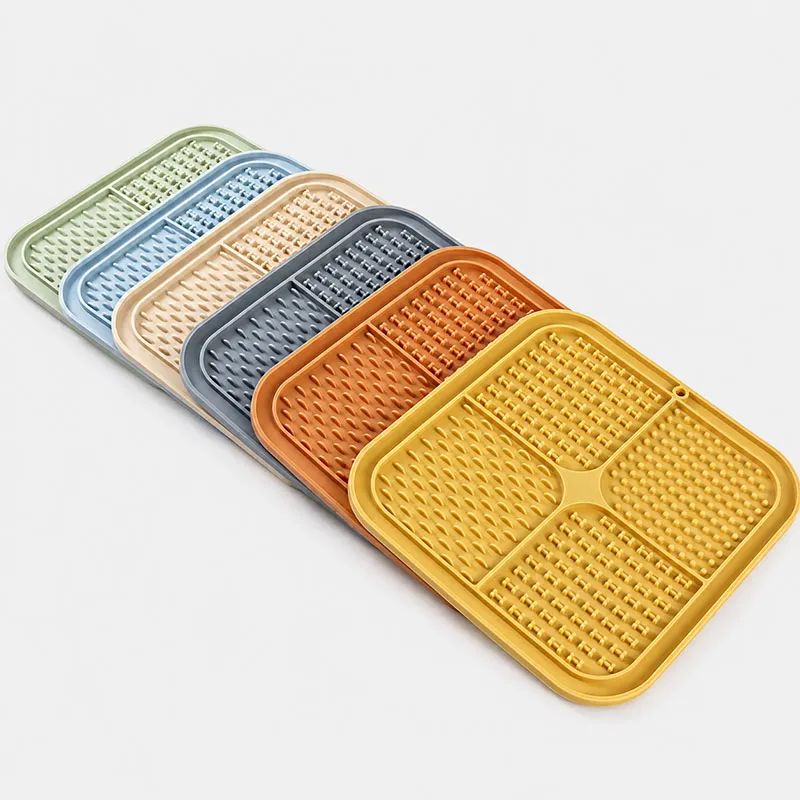
Branding a Lick Mat: Four Customization Levers That Actually Move Product
For a low-ticket item, Anpassung is what turns a generic mat into something a retailer can put a private label on and defend against a race-to-the-bottom on price.
- Color matching. Solid-color runs against a brand palette are the simplest lever and typically the fastest to sample.
- Embossed or debossed logo. Because the mat is a molded silicone part, a logo can often be built into the mold itself rather than printed on afterward, which holds up to washing better than surface printing.
- Packaging. Retail box, kraft sleeve, or hang-tag format changes the shelf presentation without touching the mold.
- Bundling with a related SKU. Pairing the mat with the rolling-ball lick bowl as a two-piece set is a way to raise average order value on two items that already ship from the same feeding-and-hydration product line.
Sample production generally runs 7–14 days, with mass production following at roughly 30–45 days after the sample is approved — the more customization stacked on (mold change versus color-only, for example), the more that timeline tends to move toward the upper end.
Where Retail Buyers Get This Wrong
The most common misstep isn’t pricing — it’s treating a lick mat and a slow feeder bowl as interchangeable and stocking only one. They answer different customer questions (“how do I occupy my dog for twenty minutes” versus “how do I stop my dog from gulping food”), and a buyer who stocks only the bowl will still field requests for a mat.
A second, smaller mistake: assuming the general feeding-line MOQ of roughly 50–200 pieces applies automatically to the lick mat SKU. That range is disclosed at the product-line level, not confirmed per item on public pages, so it needs to be verified in the quote request rather than assumed from a category-level figure.
Placing a Sample Order: The Six-Step Timeline
- Request current unit pricing and MOQ for the specific lick mat and/or lick bowl variant, not the product-line average.
- Confirm which Anpassung method applies — mold-based embossing versus surface printing — since this affects both cost and the 7–14 day sample window.
- Approve color and packaging specs before the sample is produced, not after.
- Review the physical sample for texture depth, edge finish, and whether food-contact documentation is available for that specific batch.
- Confirm trade terms (FOB, CIF, or DDP) and freight cost per unit at your target order volume.
- Place the mass-production order, budgeting roughly 30–45 days from sample approval to production completion.
Buyers running mixed containers can typically fold a lick mat order into a broader feeding-and-hydration shipment rather than ordering it as a standalone container, which is usually the more cost-effective route at this item’s price point.

FAQ
Q: Is a lick mat the same thing as a slow feeder bowl?
A: No. A slow feeder bowl uses maze walls or a rolling ball to slow the physical act of eating kibble. A lick mat uses a textured silicone surface and relies on licking rather than chewing, and it’s commonly used outside mealtime — during grooming or bathing, for example — rather than only at feeding time.
Q: What’s the wholesale price range for a silicone lick mat?
A: Publicly listed reference pricing is US$1.35–$2.80 per unit; the rolling-ball lick bowl lists at US$2.50–$3.50. Both exclude logo printing and custom packaging, which are quoted separately.
Q: Is the silicone used in these products FDA certified?
A: No specific certificate number is publicly disclosed for this item. Food-grade silicone generally falls under the FDA’s food-contact substance framework (or Regulation (EC) No 1935/2004 for the EU market), but a buyer should request the batch-specific documentation before making a certification claim on a product listing.
Q: What’s the minimum order quantity for a lick mat?
A: Not listed separately on public product pages. The broader feeding-and-hydration line typically runs 50–200 pieces depending on customization, but this should be confirmed per SKU at the quote stage.










 3. September 2026