PetNivo Tech Sourcing & Product Team | Product Sourcing & Development Team | Published September 2026
Pricing below reflects publicly listed reference figures current as of this publish date; wholesale quotes shift with quantity, customization and shipping terms, so treat every number here as a starting point for a quote request, not a fixed price.
Silicone lick mats currently list at roughly $1.35 to $2.80 per unit on the sourcing side, making them one of the lowest-cost add-ons a pet retailer can bundle next to a slow feeder bowl. This guide covers pricing, material considerations, customization options, and where buyers typically misjudge minimum order quantities.
What a Lick Mat Actually Is (And Why It’s Landing Next to Slow Feeders)
A lick mat is a flexible silicone surface, usually textured with ridges, suction cups, or raised patterns, designed for food (peanut butter, wet food, purée) to be spread across it so a dog or cat licks it off slowly. It’s a different mechanism from a slow feeder bowl: a bowl uses maze walls or a rolling ball to physically block fast bites of dry kibble, while a mat relies on surface texture and licking rather than chewing.
Retailers are increasingly racking the two together because they solve adjacent but not identical problems. A slow feeder bowl addresses mealtime speed. A lick mat addresses occupation time — grooming, bathing, vet visits, or general anxiety — which is why it shows up in checkout-lane and impulse-buy placements rather than only in the feeding aisle.
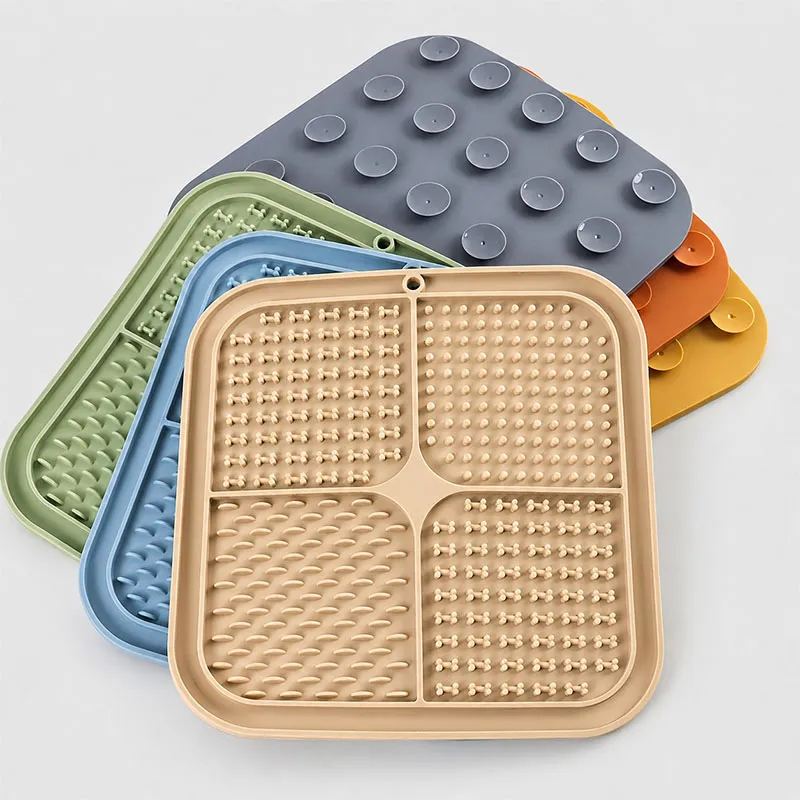
Lick Mat, Slow Feeder Bowl, or Plain Silicone Mat: How the Category Splits
Compared to standard plastic bowls typically sold in generalist pet aisles, both lick mats and slow feeder bowls add a specific mechanism the plain bowl doesn’t have — which is also why they carry a price premium over unbranded plastic.
| Attribute |
Silicone Lick Mat |
Lick Bowl w/ Rolling Ball |
Standard Plastic Bowl |
| Website reference price (wholesale, per unit) |
$1.35–$2.80 |
$2.50–$3.50 |
Not part of this product line |
| Primary mechanism |
Flat or textured surface; food is pressed into ridges |
Bowl plus a rotating ball; food coats the ball as the pet noses or licks it |
Open surface, no eating-pace mechanism |
| Best fit |
Occupying a pet during grooming, bathing, or separation anxiety |
Slowing dogs that gulp dry kibble at mealtime |
Standard feeding only |
| Dishwasher-safe claim |
Not specified on public product pages — confirm before listing this on a retail packaging insert |
Not specified on public product pages |
Not applicable |
| Wholesale MOQ |
Not listed separately for this item on public pages |
Not listed separately for this item on public pages |
Not applicable |
The gap in the MOQ and dishwasher-safe rows isn’t an oversight in this table — it’s the actual state of the publicly available product data, and it’s worth flagging to a supplier before it goes on a product page.
$1.35 to $3.50: What Wholesale Pricing Looks Like Right Now
| Product |
Website Reference Price |
| Silicone Dog Lick Mat |
US$1.35–$2.80 |
| Dog Lick / Slow Feeder Bowl with Rolling Ball |
US$2.50–$3.50 |
At a $1.35–$2.80 landed cost band, a lick mat sits well inside impulse-buy retail pricing once markup, freight, and packaging are added — which is the main reason buyers use it as a cart-add rather than a destination purchase. The trade-off is that per-unit margin dollars are small; volume, not markup percentage, is what makes the line worth carrying. A buyer stocking a single SKU at low volume will likely find the freight-per-unit cost erodes more of the margin than it would on a higher-ticket item like a $550–$700 treadmill, where freight is a smaller share of landed cost.
Neither price band above includes logo printing, custom color-matching, or retail packaging — those are quoted separately and depend on the customization level chosen.
Is Food-Grade Silicone Actually Safe for Daily Licking?
Silicone is the standard material for this category, and it’s worth being precise about what “food-grade” does and doesn’t mean here. In the United States, the FDA’s food-contact substance framework explains that materials intended to touch food may require authorization through a food-contact notification or an applicable food-additive regulation — food-grade silicone falls under this general framework, not a single blanket certificate. For products sold into the EU, Regulation (EC) No 1935/2004 sets the equivalent requirement for materials and articles that contact food.
None of this means a specific lick mat SKU carries a disclosed FDA or ISO certificate number — it doesn’t, based on currently public product-page information. A retailer building a product listing should ask the supplier directly for the applicable food-contact documentation for that specific mold and batch rather than assuming “silicone” alone satisfies the claim. Writing “FDA Certified” on a listing without that document in hand is a labeling risk, not a marketing shortcut.
Branding a Lick Mat: Four Customization Levers That Actually Move Product
For a low-ticket item, customization is what turns a generic mat into something a retailer can put a private label on and defend against a race-to-the-bottom on price.
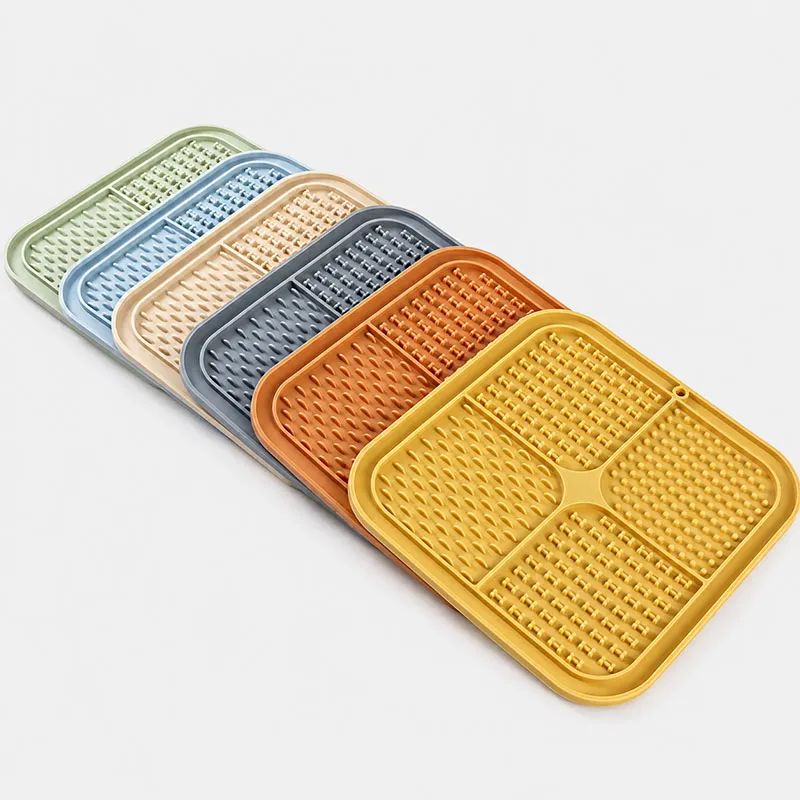
- Color matching. Solid-color runs against a brand palette are the simplest lever and typically the fastest to sample.
- Embossed or debossed logo. Because the mat is a molded silicone part, a logo can often be built into the mold itself rather than printed on afterward, which holds up to washing better than surface printing.
- Packaging. Retail box, kraft sleeve, or hang-tag format changes the shelf presentation without touching the mold.
- Bundling with a related SKU. Pairing the mat with the rolling-ball lick bowl as a two-piece set is a way to raise average order value on two items that already ship from the same feeding-and-hydration product line.
Sample production generally runs 7–14 days, with mass production following at roughly 30–45 days after the sample is approved — the more customization stacked on (mold change versus color-only, for example), the more that timeline tends to move toward the upper end.
Where Retail Buyers Get This Wrong
The most common misstep isn’t pricing — it’s treating a lick mat and a slow feeder bowl as interchangeable and stocking only one. They answer different customer questions (“how do I occupy my dog for twenty minutes” versus “how do I stop my dog from gulping food”), and a buyer who stocks only the bowl will still field requests for a mat.
A second, smaller mistake: assuming the general feeding-line MOQ of roughly 50–200 pieces applies automatically to the lick mat SKU. That range is disclosed at the product-line level, not confirmed per item on public pages, so it needs to be verified in the quote request rather than assumed from a category-level figure.
Placing a Sample Order: The Six-Step Timeline
- Request current unit pricing and MOQ for the specific lick mat and/or lick bowl variant, not the product-line average.
- Confirm which customization method applies — mold-based embossing versus surface printing — since this affects both cost and the 7–14 day sample window.
- Approve color and packaging specs before the sample is produced, not after.
- Review the physical sample for texture depth, edge finish, and whether food-contact documentation is available for that specific batch.
- Confirm trade terms (FOB, CIF, or DDP) and freight cost per unit at your target order volume.
- Place the mass-production order, budgeting roughly 30–45 days from sample approval to production completion.
Buyers running mixed containers can typically fold a lick mat order into a broader feeding-and-hydration shipment rather than ordering it as a standalone container, which is usually the more cost-effective route at this item’s price point.

FAQ
Q: Is a lick mat the same thing as a slow feeder bowl?
A: No. A slow feeder bowl uses maze walls or a rolling ball to slow the physical act of eating kibble. A lick mat uses a textured silicone surface and relies on licking rather than chewing, and it’s commonly used outside mealtime — during grooming or bathing, for example — rather than only at feeding time.
Q: What’s the wholesale price range for a silicone lick mat?
A: Publicly listed reference pricing is US$1.35–$2.80 per unit; the rolling-ball lick bowl lists at US$2.50–$3.50. Both exclude logo printing and custom packaging, which are quoted separately.
Q: Is the silicone used in these products FDA certified?
A: No specific certificate number is publicly disclosed for this item. Food-grade silicone generally falls under the FDA’s food-contact substance framework (or Regulation (EC) No 1935/2004 for the EU market), but a buyer should request the batch-specific documentation before making a certification claim on a product listing.
Q: What’s the minimum order quantity for a lick mat?
A: Not listed separately on public product pages. The broader feeding-and-hydration line typically runs 50–200 pieces depending on customization, but this should be confirmed per SKU at the quote stage.










 September 03, 2026