Late meals, empty water bowls, and poor portion control can disrupt a pet’s daily routine. These problems become worse when owners work long hours or manage several animals. A reliable automatic pet feeder and water dispenser can make feeding more consistent, controlled, and convenient.
An automatic pet feeder releases measured food at preset times, while a pet water dispenser keeps drinking water available between refills. The right system depends on the pet’s size, food type, meal schedule, and owner’s routine. Buyers should compare capacity, portion accuracy, power backup, bowl material, cleaning access, app stability, and safety features.
What Is an Automatic Pet Feeder and Water Dispenser?
An automatic pet feeder is a device that stores food and releases a set portion at a planned time. Some models use a simple timer. Others connect to an app, record feeding data, play a voice message, or include a camera.
A water dispenser serves a different purpose. It keeps water available by using gravity, a pump, or an electronic circulation system. A basic pet waterer refills a bowl as the water level drops. A cat water fountain circulates and filters water through an electric pump.
A complete feeder and water dispenser setup may include:
- A dry-food hopper
- A dispensing motor
- A programmable timer
- A removable food bowl
- A gravity water tank
- A filtered water fountain
- A stainless steel bowl
- An app or control panel
- Battery backup
- Portion and low-food alerts
A feeder should not be viewed as a replacement for daily pet care. Owners still need to check food levels, clean the equipment, monitor eating habits, and make sure fresh water remains available.
For retailers, the category offers several product levels. A basic gravity pet feeder serves value-focused customers. A programmable food dispenser fits owners who need timed meals. A smart feeder with app control, camera functions, or feeding records can support a higher retail price.
How Does an Automatic Cat Feeder Improve a Feeding Schedule?
Cats often prefer several small meals rather than one very large serving. An automatic cat feeder helps divide the daily amount into planned portions, even when the owner is away from home or asleep.
The American Animal Hospital Association states that automated feeders can help control food access and quantity. Its nutritional guidance also recommends creating a specific feeding plan that includes the diet, amount, frequency, treats, and other calorie sources.
A timed system can support:
- Early-morning meals
- Small portions throughout the day
- Controlled access to dry food
- Separate meal times in multi-pet homes
- A more predictable daily routine
- Portion management for pets that overeat
An automatic feeder may also reduce the connection between the owner and every meal. Some cats wake their owners early because they expect food. A timed cat food dispenser can release a planned portion without teaching the cat that meowing always leads to hand feeding.
However, portion settings must be tested. The number shown on the screen may represent a machine unit rather than grams. Kibble size, shape, density, and oil content can change the actual weight released.
Before regular use, owners should run several test portions into an empty food bowl and weigh them. This confirms whether the programmed amount matches the pet’s feeding plan.
An automatic cat food dispenser can support routine, but the daily food amount should still follow the pet food label and veterinary advice. Pets with diabetes, kidney disease, food allergies, weight problems, or other medical needs may require a more specific plan.

Should You Choose a Dry Food or Wet Food Feeder?
Most automatic feeders are designed for dry food. Kibble moves through a rotating wheel, screw, or segmented outlet and drops into a bowl. This structure is relatively simple, easy to store, and suitable for several meals.
A dry food feeder should protect the food from moisture and curious paws. The lid needs a secure lock, and the outlet should be small enough to prevent the pet from reaching into the hopper. A desiccant holder may help manage moisture, but it does not replace proper food storage.
The FDA advises owners to keep dry pet food in a cool, dry place below 80°F and preferably retain it in the original bag so that the product name, lot number, and best-by date remain available.
A wet food feeder requires a different design because moist food spoils more quickly. Common systems include:
- Ice-pack tray feeders: Removable cold packs sit beneath covered meal compartments.
- Rotating tray feeders: A lid opens over one compartment at a planned time.
- Refrigerated feeders: Electronic cooling keeps unopened portions chilled.
- Single-meal lid feeders: A sensor or timer opens the cover for one serving.
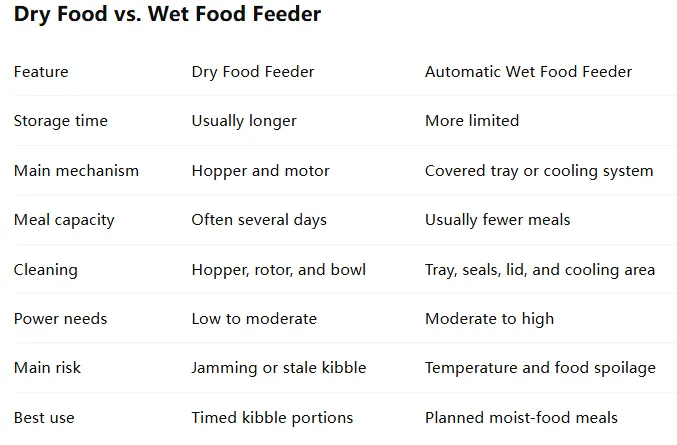
An automatic wet food cat feeder must manage temperature and hygiene carefully. Leftover moist food should not remain warm for long periods.
The FDA advises pet owners to refrigerate or discard unused canned and pouched food promptly and keep refrigerators at 40°F or below. It also recommends washing and drying pet food bowls after each use.
Some newer products use electronic cooling. For example, the Petlibro Polar wet food feeder is marketed with three food compartments, semiconductor cooling, app scheduling, and a covered tray. Its manufacturer instructs users not to keep food in the unit for longer than three days and lists temperature-related operating limits. These are manufacturer-specific claims and should not be treated as universal standards for every automatic wet feeder.
Retailers comparing the best automatic wet feeder should inspect real cooling performance, room-temperature limits, tray seals, condensation control, backup power, and cleaning access.
What Is the Difference Between a Gravity Feeder and an Automatic Feeder?
A gravity pet feeder does not use a motor or timer. Food moves from a storage container into the bowl as the pet eats. It is affordable and simple, but it does not control when or how much the animal consumes.
A gravity cat feeder may suit pets that manage free-choice feeding well. It is less suitable for animals that overeat, need measured portions, or require medication-linked meal times.
An electronic automatic feeder releases a controlled amount according to a programmed schedule. This gives the owner more control, but it also introduces motors, sensors, batteries, cables, and software.
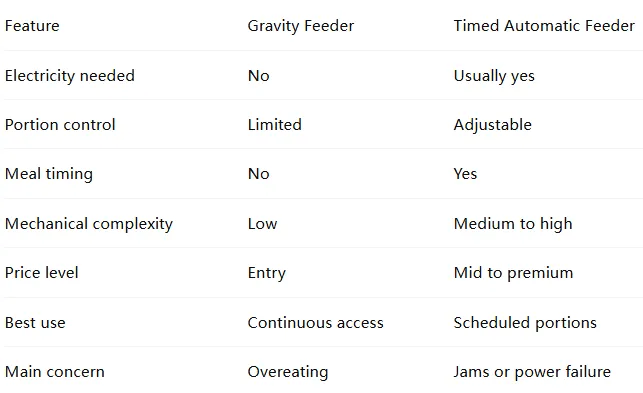
The same distinction applies to water. A gravity pet water dispenser allows water to flow into the bowl as the level drops. An automatic water bowl may use a valve, pump, sensor, or connection to a larger water source.

Which Pet Water Dispenser Works Best for Cats and Dogs?
Water systems generally fall into three groups: gravity tanks, circulating fountains, and sensor-based dispensers.
A gravity pet water dispenser is easy to understand. The tank feeds water into the bowl until the desired level is reached. It works without electricity, but the bowl remains open and can collect hair, food, dust, and saliva.
A cat water fountain circulates water through a pump and often includes a replaceable filter. Some cats appear interested in moving water, but fountain use does not remove the need for regular cleaning and water replacement.
The AVMA recommends washing pet food bowls, water bowls, feeding mats, and related feeding tools frequently with hot, soapy water. The FDA specifically advises washing water bowls daily.
Water Dispenser Comparison
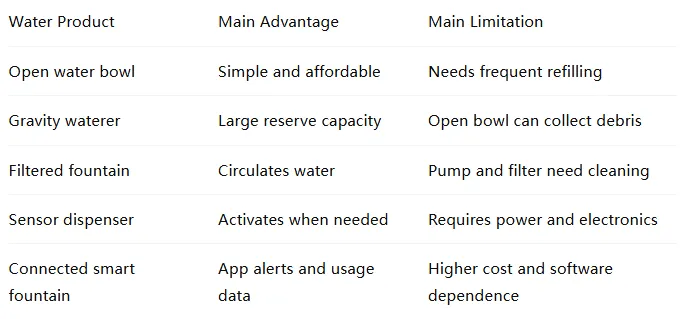
A pet water feeder should have:
- A stable base
- A wide drinking area
- Rounded internal corners
- Easy tank removal
- A valve that does not leak
- Food-contact-suitable materials
- Replaceable filters when applicable
- A pump that can be opened for cleaning
- Clear minimum and maximum fill marks
A large tank is not always better. Water that remains in a warm room for too long can become less appealing and may collect debris. Capacity should match the number and size of pets while still allowing regular washing and refilling.
Retailers offering an automatic cat feeder and water product should consider whether a combined unit is truly practical. Food crumbs can enter a nearby water bowl, and a leak may affect the feeder’s electronic components.
In many cases, a coordinated feeder and water dispenser set is better than one physically connected machine. The two products can match in color and style while remaining separate for safer cleaning and flexible placement.
Are Wi-Fi Smart Cat Feeders Worth Buying?
A smart cat feeder connects to a mobile app through Wi-Fi. Depending on the product, the app may schedule meals, release food manually, record feeding events, warn of low food, or alert the user when a jam occurs.
A Wi-Fi automatic cat feeder offers real value when the functions solve practical problems. Remote control can help an owner adjust a meal while away. Feeding records can show whether the device released food as planned.
However, a smart feature is only useful when it works reliably. A feeder should continue following its saved schedule if the internet connection fails. It should also retain settings after a brief power interruption.
Buyers should examine:
- Support for 2.4 GHz or dual-band Wi-Fi
- Whether a 5G Wi-Fi automatic model truly supports 5 GHz
- App availability in target countries
- Account setup and password requirements
- Firmware-update support
- Offline schedule operation
- Data and privacy policies
- Notification accuracy
- Shared access for family members
- Battery backup
The phrases “5G Wi-Fi automatic” and “5G Wi-Fi automatic dog feeder” are often used loosely. Some listings mean 5 GHz home Wi-Fi, while others may simply use “5G” as promotional language. Technical documentation must state the supported frequency bands clearly.
A smart cat feeder also needs useful physical controls. Owners should be able to release food, lock buttons, and check basic status without opening the app every time.
Searches for products such as the Petlibro Air Wi-Fi Feeder, Petlibro automatic cat feeder, PETKIT automatic cat feeder, Oneisall automatic cat feeder, and Imipaw automatic cat feeder show that buyers compare connectivity, portion control, price, design, and brand trust. A private-label product should not copy another brand’s shape, interface, packaging, or protected claims.

What Should You Look for in a Feeder With Camera Functions?
A feeder with camera combines meal dispensing with remote viewing. It may include live video, motion detection, night vision, two-way audio, recorded clips, or pet notifications.
For an owner, the camera can show whether food reached the bowl and whether the pet approached the feeder. It can also help identify food stealing in a multi-pet home.
A camera does not prove that the animal ate the correct amount. The bowl may be blocked from view, another pet may eat the meal, or the device may record motion without showing clear food intake.
An automatic cat feeder with camera should be reviewed for:
- Camera angle
- Video resolution
- Night visibility
- Microphone quality
- Speaker volume
- Storage options
- Subscription requirements
- App permissions
- Privacy controls
- Status lights
- Lens protection
- Reset and account-transfer procedures
A dog feeder with camera may need a stronger body and a higher camera position. A low cat model may provide a better close view of the food bowl.
Privacy also matters. A camera placed inside a home can capture people as well as pets. Retail packaging and manuals should explain account security, cloud storage, local storage, microphone use, and how to delete personal data.
From a B2B perspective, customer support is critical. A camera-based feeder produces more setup questions than a basic food bowl. Buyers should plan app instructions, troubleshooting guides, warranty rules, and replacement support before launch.
Which Materials Make a Pet Feeder Easy to Clean?
Food-contact surfaces must be smooth, durable, and simple to remove. Deep corners, decorative grooves, exposed screws, and narrow food paths can trap oil and crumbs.
A feeder with stainless steel bowl offers a clear selling point. Stainless steel is rigid, washable, and familiar to pet owners. The bowl should still have a smooth rim, stable fit, and finish that resists visible scratches.
A stainless steel food bowl can sit inside a plastic base, allowing the bowl to be removed for washing while keeping the electronic parts dry.
Useful material combinations include:
- ABS or PP housing
- Stainless steel bowl
- Silicone sealing ring
- Transparent food hopper
- Food-contact-suitable rotor
- Rubber anti-slip feet
The phrase stainless steel cat feeder may describe a fully metal product or simply a feeder with a steel bowl. Product pages should explain which parts are metal.
A steel cat feeder and water system can look premium, but too much metal may increase shipping cost, noise, fingerprints, and production expense. Material selection should follow function rather than appearance alone.

Easy-Clean Design Checklist
- Removable bowl
- Detachable hopper
- Accessible dispensing wheel
- Rounded food-contact corners
- Washable lid seal
- No exposed electronics
- Minimal gaps near the outlet
- Clear hand-wash or dishwasher instructions
- Replaceable parts
- Drying space around the bowl
How Do You Choose the Correct Feeder Capacity?
Capacity should match the pet’s daily portion, the owner’s refill routine, and the freshness needs of the food. A very large hopper may reduce refill frequency but keep kibble inside the machine for a long time.
Manufacturers often describe capacity in liters. Pet owners feed in grams or cups. Because different kibble products have different densities, liter capacity does not show the exact number of meals.
A better product page should provide:
- Hopper volume in liters
- Tested kibble-size range
- Approximate food weight range
- Portion range in grams
- Number of programmable meals
- Maximum portions per meal
- Recommended pet size
- Estimated days of use with clear assumptions
What Safety Features Should an Automatic Pet Feeder Include?
A reliable automatic feeder must protect the animal, the food, and the feeding schedule. Convenience comes second.
Important features include:
- Anti-jam detection: Stops or reverses the motor when food blocks the outlet.
- Anti-pinch design: Prevents moving lids from closing on a paw or head.
- Secure hopper lock: Stops animals from opening the lid.
- Food-out alert: Warns the owner before the hopper becomes empty.
- Battery backup: Maintains scheduled meals during a power failure.
- Low-battery alert: Gives time to replace batteries.
- Pet-resistant buttons: Prevents accidental changes.
- Stable base: Reduces tipping and food spills.
- Protected power cable: Limits chewing access.
- Safe reset behavior: Prevents unplanned food release after restart.
Power backup needs careful wording. Some models run the full machine from batteries, while others only preserve settings. Buyers should test what happens when the plug is removed during an active feeding schedule.
An automatic dog feeder may need a stronger lid and body than a model intended only as a feeder for cats. Dogs may push, bite, or tip the unit with more force.
What Should B2B Buyers Inspect Before Bulk Ordering?
A sample may look impressive in product photos and still fail during long-term use. B2B buyers need to test the complete system before approving production.
At PetNivo Tech, we recommend dividing inspection into five areas.
Feeding Performance
- Portion accuracy
- Meal-time accuracy
- Kibble compatibility
- Jam frequency
- Food remaining in the outlet
- Hopper sealing
- Pet access to stored food
Electrical Performance
- Adapter specification
- Plug type
- Battery operation
- Power-loss behavior
- Motor life
- Wi-Fi connection stability
- App response
- Firmware update process
Physical Quality
- Housing fit
- Bowl stability
- Lid locking
- Button response
- Sharp edges
- Surface scratches
- Odor
- Cable protection
- Carton protection
Hygiene and Maintenance
- Bowl removal
- Hopper removal
- Rotor cleaning
- Water resistance around electronics
- Food-contact material documentation
- Cleaning instructions
- Availability of replacement parts
Packaging and Market Readiness
- Brand logo
- Retail box
- Barcode
- Plug and voltage label
- User manual
- App download method
- Privacy information
- Warranty statement
- Importer details
- Destination-market compliance

How Does PetNivo Tech Support OEM and Private-Label Feeder Projects?
PetNivo Tech is a China-based B2B pet supplies sourcing and OEM/private-label partner. We support retailers, distributors, importers, e-commerce sellers, and private-label brands that need market-ready dog, cat, and bird products.
For automatic feeder and pet water projects, our services can include:
- Supplier research and comparison
- Existing-model selection
- Product sample coordination
- Feeding-performance testing
- Material and certification review
- Color and logo customization
- Bowl and accessory matching
- Packaging development
- User-manual coordination
- Quality-control inspection
- Spare-part planning
- Export packaging
- Shipment coordination
We do not automatically describe every product as coming from one PetNivo-owned factory. Our role is to integrate suitable supply-chain resources, compare manufacturing options, coordinate quality requirements, and help the buyer reduce sourcing risk.
PetNivo can also help connect automatic feeding products with related categories:
This makes it easier for an overseas buyer to develop a coordinated pet feeding collection rather than sourcing each item through an unrelated supplier.
OEM Options
Depending on the model and order quantity, available customization may include:
- Custom housing colors
- Logo printing
- Molded or engraved branding
- Stainless steel bowl finish
- Voice prompts
- App branding
- Retail packaging
- Multilingual manuals
- Barcode labels
- Power adapters
- Plug types
- Filter and accessory bundles
Private app development, exclusive tooling, and structural changes normally require higher order quantities, longer testing, and more development investment than simple logo or packaging customization.
Our aim is to help the buyer choose the right level of customization for the expected sales volume and target price.
B2B Automatic Feeder Buying Checklist
Before placing a wholesale order, confirm:
- Intended animal and size
- Dry or wet food use
- Compatible kibble dimensions
- Hopper or tray capacity
- Portion range
- Number of scheduled meals
- Portion accuracy tolerance
- Jam-detection method
- Anti-pinch protection
- Lid-lock design
- Bowl material
- Food-contact documents
- Adapter and plug type
- Battery backup function
- Wi-Fi frequency
- Offline operation
- App availability
- Data and privacy policy
- Camera storage plan
- Cleaning method
- Replacement parts
- Packaging structure
- Drop-test standard
- Warranty period
- Inspection criteria
- Carton dimensions
- Container-loading quantity
A successful pet feeder must satisfy three groups:
- The animal: reliable food access and a comfortable bowl
- The owner: easier scheduling, cleaning, and monitoring
- The retailer: clear positioning, stable quality, and manageable support
FAQ
Are automatic pet feeders safe?
A properly designed feeder can be safe when owners select the correct model, test the portion size, clean it regularly, and check it every day. Useful safety features include anti-jam detection, a secure lid, stable construction, battery backup, and protected moving parts.
Can an automatic cat feeder replace a pet sitter?
No. It can support scheduled meals, but it cannot check the pet’s health, clean litter boxes, refresh water, handle emergencies, or confirm that the animal is behaving normally. Owners still need a responsible person to check the pet during longer absences.
Can I put wet food in a normal automatic feeder?
Only when the product is specifically designed for moist food. A normal hopper feeder is usually intended for dry kibble. Wet food can block the mechanism, contaminate internal parts, and spoil if it is not kept at a safe temperature.
How long can wet food remain in an automatic feeder?
The answer depends on the feeder’s cooling method, room temperature, food type, and manufacturer instructions. Unused canned or pouched food should be refrigerated promptly or discarded. A chilled or refrigerated feeder must be used within its stated limits.
Is a gravity feeder better than an automatic feeder?
A gravity feeder is simpler, cheaper, and does not need power. A programmable automatic feeder offers better meal timing and portion control. The better choice depends on whether the pet can safely manage continuous access to food.
What is the best automatic cat feeder?
The best automatic cat feeder is one that matches the cat’s food type, daily portion, meal schedule, and behavior. It should dispense accurately, resist jams, keep food secure, retain schedules during connection loss, and have removable washable food-contact parts.
Do automatic feeders work without Wi-Fi?
Many models can follow a saved feeding schedule without an active internet connection, but this varies by design. App control and alerts may stop when Wi-Fi is unavailable. Buyers should test offline operation before approving a smart feeder.
How often should an automatic feeder be cleaned?
The food bowl should be cleaned after use or at least daily, depending on the food type. Wet-food trays require cleaning after every meal cycle. The hopper and dispensing path should be cleaned according to the manufacturer’s instructions and whenever oil, crumbs, or residue build up.
Is stainless steel better than a plastic food bowl?
Stainless steel is durable and easy to wash, while plastic is lighter and allows more colors and shapes. The complete design matters most. The bowl should be removable, smooth, stable, and suitable for food contact regardless of material.
Can one automatic feeder serve two pets?
It can, but one animal may eat more than its share. Separate feeders, controlled feeding areas, or identification-based access systems are often better when animals require different portions or diets.










 July 31, 2026