A bored indoor cat may scratch furniture, compete for sleeping space, or struggle to find a quiet retreat. These problems become worse in small homes and multi-cat households. A stable multilevel plush cat tree combines climbing, scratching, play, and rest in one organized activity center.
A good multi-level cat tree should have a wide, stable base, full-height sisal scratch posts, easy climbing routes, roomy platforms, and secure resting areas. Choose the height and perch size for the cat’s age and weight. Large cats need wider beds, thicker posts, stronger connectors, and a wall anchor for added stability.
What Is a Multilevel Plush Cat Tree?
A multilevel plush cat tree is a freestanding piece of cat furniture with several raised platforms connected by posts, ramps, steps, or enclosed resting spaces. It usually combines a cat tower, sleeping area, play structure, and cat scratching post in one product.
A typical design may include:
- A stable baseboard
- Several vertical support posts
- A top perch
- One or more condos
- A hammock
- Sisal-covered scratching posts
- Padded perches
- A scratching board
- Hanging toys
- A ladder or ramp
- Removable resting pads
The levels create separate zones for different activities. A cat can scratch near the bottom, climb through the middle, sleep inside a cozy condo, and watch the room from a raised platform.
This is more useful than simply making the structure tall. A well-planned cat tree tower gives the animal clear routes between each level. The gaps should not be too wide, the openings should not be too small, and the platforms should support safe landing.
In our PetNivo sourcing work, we study how the complete structure functions rather than counting features alone. A model advertised with 2 caves, 5 scratching posts, a spacious hammock, and dangling balls may sound impressive. However, those features provide little value when the platforms are too small or the base moves during climbing.

Why Do Indoor Cats Need Vertical Space?
Cats naturally seek raised areas where they can rest and watch their surroundings. International Cat Care explains that high resting places can help cats feel safe and recommends options such as cat trees, towers, shelves, and platforms. Resting areas should also be large enough for the animal to lie comfortably.
The Feline Veterinary Medical Association identifies safe spaces, scratching areas, sleeping areas, and play opportunities as important parts of a cat-friendly environment. It also recommends separating key resources so animals can use them without competition or perceived threats.
A multi-level cat tower can support several of these needs by providing:
- Raised observation points
- Private resting spaces
- Separate activity zones
- Climbing opportunities
- Scratching surfaces
- Short play sessions
- A retreat from household activity
This is especially useful for an indoor cat that has limited access to outdoor climbing and exploration. A cat tower for indoor cats cannot replace interactive play, but it can add more choice to the home.
Vertical space may also help multi-cat households use the room more efficiently. Two cats may avoid direct conflict by choosing different heights or resting zones. Still, one tower should not become the household’s only sleeping, scratching, or hiding resource. Current feline environmental guidance recommends providing multiple separated resources where competition may occur.
Which Cat Tower Features Support Natural Scratching?
Scratching is normal feline behavior. Cats scratch to maintain their claws, stretch muscles, mark their environment, and communicate. The goal is not to stop the behavior but to provide suitable surfaces in the right locations.
International Cat Care recommends scratching structures that allow a full body stretch. Some cats prefer vertical surfaces, while others prefer horizontal or angled surfaces. Materials may include sisal, cardboard, wood, carpet, or other textures.
A cat tower with scratching posts should therefore offer more than short decorative sections. Useful scratch features include:
- Tall vertical posts
- Natural sisal rope
- Wide scratching panels
- Angled boards
- Reachable surfaces near resting areas
- Replaceable rope sections
- Posts that do not rotate or bend
The RSPCA advises providing a scratching post that is tall and sturdy enough to remain stable while a cat stretches fully.
For product development, the length of the exposed sisal matters. A post may look fully wrapped in a photograph but leave only a small usable area between two platforms. The animal should be able to extend its front legs and pull downward without striking the platform above.
Scratching Surface Comparison
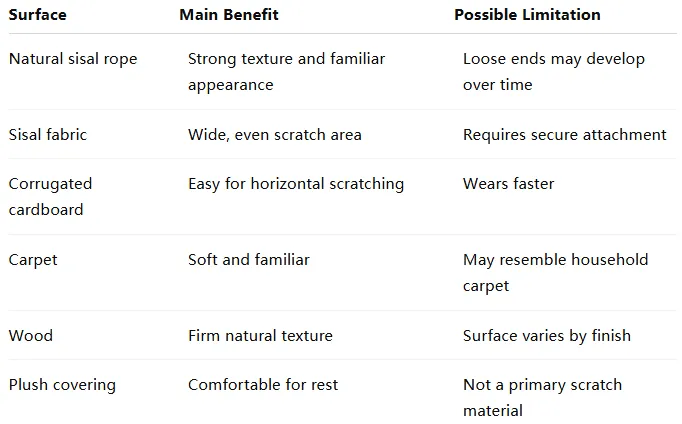
A plush condo with scratching posts can satisfy both rest and scratch needs when the materials remain clearly separated. The soft surface belongs on the cat bed and platforms. The rough sisal belongs on the scratch posts.
A good product can include sisal-covered scratching posts at several levels. This gives the animal more than one location to scratch and reduces wear on a single lower post.

How Many Levels, Condos, and Perches Should a Cat Tree Have?
More levels do not automatically create a better product. The layout must match the intended animal and available floor space.
A compact three-level tower may suit a kitten or small cats. A taller activity tower may work better for active adults. A large cat tower should include broad platforms and shorter, well-supported jumps rather than narrow shelves arranged mainly for appearance.
Common configurations include:
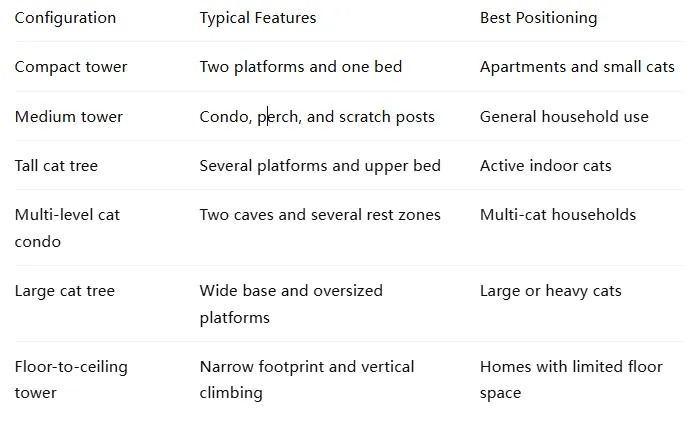
A top perch often becomes a key selling feature because it provides a high resting place. It should be wide enough for the intended user to turn and lie down without hanging over every edge.
A large top perch may use a raised padded rim to create a nest-like bed. Buyers should measure the usable inner area rather than the full outside dimensions. Thick borders can make a bed look large while reducing actual sleeping space.
The same rule applies to a condo for cats. Check:
- Internal width and depth
- Entrance diameter
- Entry height
- Ventilation openings
- Structural support
- Whether the cat can turn inside
- Whether the cover can be cleaned
A roomy condo can serve as a private retreat, while a second cave gives another animal a separate space. In multi-cat homes, duplicated features can reduce competition, although separate resources elsewhere in the home remain important.
A hammock adds a softer resting option. It must attach securely at several points and have enough depth to support the animal without allowing the fabric to touch moving hardware.

What Makes a Large Cat Tree Sturdy and Stable?
Stability begins at the bottom. A tall cat tree with a narrow or lightweight base can sway when an animal jumps onto an upper platform. That movement may frighten the user and reduce repeat use.
Cats Protection and the RSPCA both emphasize that scratching structures should be sturdy enough to withstand a cat leaning and stretching against them.
A sturdy and stable cat tree usually needs:
- A broad, heavy base
- Thick vertical posts
- Strong threaded connectors
- Well-supported upper platforms
- Balanced weight distribution
- Anti-slip floor protection
- Secure hammock fittings
- A wall-anchoring accessory for tall models
A large cat creates greater force when running, jumping, or landing. For this reason, a large cat tree should not simply be a standard model with wider plush perches. The posts, base, hardware, and connection points must also be strengthened.
Practical Stability Inspection
At PetNivo, we recommend checking the sample in several ways:
- Assemble it according to the supplied manual.
- Confirm that every bolt reaches the threaded insert fully.
- Press each platform from the front and sides.
- Apply downward force to the top perch.
- Check for rocking on a flat floor.
- Inspect the post connections after repeated movement.
- Test the wall strap and mounting hardware.
- Recheck every connection after several days.
A wall anchor can add protection, but the attachment method must suit the wall type. The manual should tell the customer to use appropriate hardware and seek professional installation support when needed.
An extra large model also needs careful carton planning. Heavy boards packed without corner protection may arrive chipped. Long posts can move inside the carton and damage plush surfaces or hardware bags.
The product should include clearly labeled components, organized fasteners, and an assembly tool. “Easy to assemble” should mean that the instructions, hole positions, part numbers, and fittings have been verified on a real sample.
Are Plush Fabric and Sisal Suitable Cat-Tree Materials?
A cat tree with plush covering creates a soft, warm appearance. Plush fabric can cover platforms, condos, bed rims, and the main base. Common retail colors include beige, light gray, cream, brown, and charcoal.
A soft plush fabric surface feels comfortable for rest, but quality varies. Low-density material may flatten quickly or expose the board beneath. Loose fibers, uneven glue, visible staples, and open seams can also reduce product quality.
Buyers should compare:
- Fabric density
- Fiber shedding
- Color consistency
- Seam quality
- Adhesive odor
- Resistance to pulling
- Ease of spot cleaning
- Coverage around board edges
A removable pad offers easier cleaning than a fully fixed plush covering. It can also create replacement-accessory opportunities for private-label brands.
Sisal is commonly used on cat furniture because its coarse surface gives claws a strong grip. Both rope and woven sisal panels can work well, provided they remain securely bonded to the post.
Natural sisal rope should be wrapped tightly with minimal gaps. The top and bottom ends need secure fixing so the rope does not unwind after repeated use.
Plush, Wood, or Hybrid Cat Furniture?
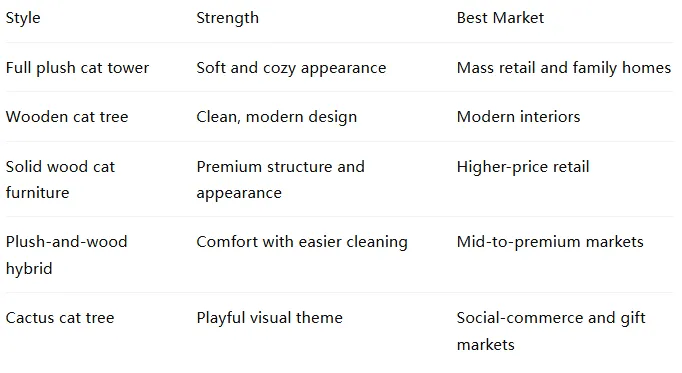
A modern cat tree may use veneered or painted boards with removable cushions instead of full plush coverage. This style can look cleaner in modern homes and may be easier to wipe.
A solid wood cat design can support premium positioning, but buyers should confirm the real material. “Solid wood,” plywood, particleboard, and MDF are not interchangeable terms.

Is a Multilevel Cat Tower Suitable for Multiple Cats?
A multilevel tower can serve multiple cats when it offers several routes, duplicated rest areas, and enough structural strength. A product with only one desirable top perch may create competition even when the lower levels remain empty.
Current feline environmental guidance recommends multiple and separated resources in homes with more than one cat. Safe spaces should allow animals to choose distance from each other, and each cat should have access to essential resources without being blocked.
Useful features for multi-cat households include:
- Two condos
- More than one hammock or cat bed
- Several plush perches
- Multiple scratch posts
- A broad base
- Separate climbing paths
- Wide middle platforms
- High total weight capacity
A product with 5 scratching posts may spread wear and give feline friends more choice. However, post count alone does not guarantee usability. Each scratch zone should be accessible and long enough for meaningful use.
A multi-level cat condo should also avoid narrow dead ends. When two animals meet inside a small upper area, they should have a safe way to move apart.
Pet owners should still provide other beds, scratching areas, litter boxes, food stations, and water points around the home. One activity center should not become the only valuable resource.
Where Should a Cat Tree Be Placed in the Home?
Placement strongly affects use. A high-quality cat house may remain empty when it sits in an isolated storage room.
Many cats enjoy watching people, observing outdoor movement, or resting near familiar activity. A tower beside a secure window can provide visual interest, while a position near a regular sleeping area may encourage scratching after waking.
International Cat Care recommends offering high resting locations that allow cats to observe their surroundings. It also stresses that cats must be able to reach and leave those spaces safely.
Good placement options include:
- Near a secure window
- Beside a sofa or family area
- Close to an existing sleeping place
- Near furniture the cat already scratches
- In a quiet corner with a clear room view
- Away from unstable shelves or breakable objects
ASPCA guidance recommends placing suitable scratch surfaces near objects the cat already chooses to scratch. It also advises offering sturdy structures and different scratch materials.
Avoid placing the tower:
- Directly beside a loud appliance
- Where a door may strike it
- On an uneven floor
- Against an unsafe or unsecured window
- Near open flames
- Under unstable objects
- Where the wall anchor cannot be used correctly
Do not force the animal onto the tower. Place familiar toys or a small amount of catnip on lower levels when appropriate, then allow exploration at the cat’s own pace. Forced scratching can frighten an animal and create avoidance.
Dangling balls can attract attention, but the cord length and attachment strength require inspection. Remove damaged toys immediately, and supervise animals that chew strings or elastic.

What Should B2B Buyers Inspect Before Bulk Ordering?
A cat tree is a furniture product made from several components. Quality problems can appear in boards, fabric, posts, glue, metal fittings, toys, packaging, or instructions.
At PetNivo Tech, we recommend dividing inspection into five areas.
Structure and Dimensions
- Baseboard thickness
- Post diameter
- Total height
- Platform size
- Condo dimensions
- Perch diameter
- Hammock depth
- Finished product weight
- Recommended load
- Wall-strap position
Materials and Workmanship
- Board type
- Plush fabric weight
- Sisal rope thickness
- Rope wrapping quality
- Exposed staples
- Sharp edges
- Glue marks
- Odor
- Fabric shedding
- Surface color consistency
Hardware and Assembly
- Bolt length
- Threaded insert strength
- Hole alignment
- Tool quality
- Spare hardware
- Part labels
- Manual accuracy
- Assembly time
- Final movement or wobble
Cat-Use Details
- Climbing route
- Landing space
- Full-stretch scratch area
- Entry size
- Bed comfort
- Toy-cord safety
- Scratch-board position
- Access for different age groups
Packaging and Export
- Carton strength
- Corner protection
- Moisture protection
- Hardware bag security
- Barcode placement
- Retail labels
- Multilingual manual
- Drop-test requirements
- Pallet or container loading
How Can PetNivo Support OEM and Private-Label Cat Furniture?
PetNivo Tech is a China-based B2B pet supplies sourcing and OEM/private-label partner. We work with global pet retailers, distributors, importers, e-commerce sellers, and private-label brands.
For cat tree and cat furniture projects, our support can include:
- Product and supplier research
- Existing-design comparison
- Sample coordination
- Size and stability review
- Material option comparison
- Custom color selection
- Logo and packaging development
- Instruction-manual coordination
- Quality-control inspection
- Carton optimization
- Spare-part planning
- Export and shipment coordination
We do not present every product as coming from one PetNivo-owned factory. Our role is to integrate suitable supply-chain resources, identify the right manufacturing option, coordinate buyer requirements, and reduce sourcing risk.

Common OEM Options
Depending on the design and order quantity, buyers may request:
- Beige, light gray, cream, or custom plush
- Different sisal-rope colors
- Wider top platforms
- Larger condo entrances
- Removable sleeping pads
- Custom hanging toys
- Printed or engraved logos
- Exclusive retail cartons
- Multilingual instructions
- Replacement posts or pads
- Modified heights and layouts
Structural changes require more review than color changes. A wider platform affects balance. A taller post changes leverage. A larger condo increases weight. These modifications should be tested as a complete structure.
PetNivo can also coordinate cat towers with related products, including scratching boards, cat beds, litter solutions, carriers, feeding products, water dispensers, smart feeders, stairs, ramps, and other pet supplies.
This allows an overseas buyer to build a coordinated cat-care collection rather than sourcing every item separately.
Illustrative Private-Label Cat Tree Case Study
Consider an online retailer that sells scratchers and beds but does not yet carry large cat furniture. Customer reviews show demand for taller products, stronger posts, and larger sleeping areas.
Instead of launching ten models, the retailer develops three:
- A compact kitten activity center
- A medium plush tower with one condo and hammock
- A reinforced large cat tree with two caves and a large top perch
PetNivo coordinates sample comparisons and finds that the first large model uses attractive plush but has a narrow base. The structure moves when the upper platform is pressed. A second option uses a wider base, thicker sisal posts, and stronger metal fittings.
The retailer chooses the more stable model, adjusts the packaging, adds clearer part labels, and offers replacement scratch posts. The final range gives shoppers clear size choices and reduces the risk of launching a visually appealing but weak product.
That is how sourcing should work: not only finding an item, but checking whether it can support the buyer’s market position and long-term brand reputation.
B2B Multilevel Cat Tree Buying Checklist
Before placing a wholesale order, confirm:
- Intended cat size
- Recommended load
- Total height
- Base dimensions
- Board material and thickness
- Post diameter
- Sisal rope specification
- Full usable scratch length
- Perch and hammock dimensions
- Condo internal size
- Fabric type and weight
- Removable-pad options
- Wall-anchor system
- Hardware specification
- Assembly-manual accuracy
- Spare parts
- Logo method
- Retail packaging
- Carton dimensions
- Drop-test requirements
- Quality-inspection criteria
- Container-loading quantity
A successful cat tree must satisfy three groups:
- The cat: safe climbing, scratching, resting, and hiding;
- The owner: stable construction, practical assembly, and manageable cleaning;
- The retailer: clear positioning, consistent quality, and workable shipping costs.
Frequently Asked Questions
What is the best height for a cat tree?
The best height depends on the cat’s age, mobility, activity level, and the available room. Active adults may enjoy a tall cat tree, while kittens and senior cats often benefit from smaller height changes and wider landing areas. Every model should remain stable during full-stretch scratching and jumping.
Are cat trees good for indoor cats?
Yes. A cat tree for indoor cats can provide climbing, elevated rest, scratching surfaces, hiding spaces, and play opportunities. It should form part of a wider environment that also includes interactive play, separate resources, and positive human interaction.
What size cat tree is suitable for a large cat?
Choose a model with a broad base, thick posts, strong connectors, wide platforms, and an oversized resting bed. Check the usable dimensions and stated load rather than relying only on the phrase “large cat tree.”
Is sisal rope safe for scratching posts?
Sisal is widely used as a scratch surface because its rough texture gives claws a firm grip. Owners should inspect it regularly and remove or repair loose rope ends before the material unwinds.
How many scratching posts should a cat tower have?
There is no fixed number. The posts should be accessible, stable, and long enough for full stretching. A multilevel model may benefit from several scratch areas because it gives the animal more choice and spreads wear.
Is a plush cat tower easy to clean?
Fixed plush is usually cleaned with vacuuming and spot treatment. Removable pads are easier to wash. Buyers should follow the care instructions and avoid soaking boards or glued post structures.
Can two cats share one cat tree?
They can share a strong multi-level cat condo, but the structure should have several resting areas and safe routes. Multi-cat households should also provide separate scratching, sleeping, feeding, drinking, and toileting resources elsewhere in the home.
Should a tall cat tower be attached to the wall?
A wall anchor can improve the stability of a tall or narrow tower. Follow the assembly instructions and use fixings suitable for the wall type. The base should still remain stable before anchoring.
Where should I put a cat tower?
Place it on a level floor in a location the animal already enjoys, such as near a secure window, family area, sleeping place, or existing scratch location. Keep it away from hazards, unstable objects, open flames, and doors that may strike it.
How often should cat-tree bolts be checked?
Check every connector after initial assembly, again after the first period of use, and regularly thereafter. Tighten loose fittings and replace damaged posts, toys, fabric, or hardware before allowing continued use.










 July 31, 2026