PetNivo Tech Quality Control Team | Quality Control / Product Inspection | Published/Updated: August 2026
The Automatic Pet Hair Dryer Box measures 380 × 540 × 400 mm, runs at 35–45 °C across three speed settings, and carries a 20-unit MOQ at a US$86–96 reference price. What that spec sheet does not state is voltage, rated power, or which safety documents exist. Those blanks decide the order.
Reference prices and specifications below come from PetNivo Tech’s published product page. They are screening figures rather than quotations, and the documentation status described here reflects what is publicly disclosed at the time of writing. Confirm both before committing.
| Parameter |
Disclosed value |
| Product dimensions |
380 × 540 × 400 mm |
| Intended animal size |
Cats and small dogs |
| Airflow pattern |
360° drying |
| Temperature range |
35–45 °C / 95–113 °F |
| Speed settings |
Three, adjustable |
| Over-temperature protection |
Automatic shutdown |
| Anti-scalding construction |
Yes |
| Anti-hair-pinch design |
Yes |
| MOQ |
20 units |
| Website reference price |
US$86–96 |
| CE / FCC / UL / ETL / RoHS certificate number |
Not publicly disclosed |
The disclosed spec sheet
At MOQ that works out to roughly US$1,720–1,920 for a first order before freight. For a retailer, this is a low enough commitment to test the category on a shop floor and high enough that the wrong specification ties up capital in a product you cannot legally sell.
What the spec sheet leaves out
Every field below is standard on an electrical appliance quotation and none of it appears on the public page. Request all of them in writing before you sample.
Voltage and frequency. A unit built for 220–240 V / 50 Hz will not run on a 110 V / 60 Hz supply, and a step-down transformer is not a retail-grade solution to sell alongside the product. Confirm which voltage version is being quoted and whether both are available. This is the single most common source of a dead-on-arrival first order in small appliances.
Plug type. Type A/B for North America, Type I for Australia, Type C/N for parts of South America. Ask whether the plug is molded to the cable or supplied as a detachable cord set, since a detachable cord makes multi-market stocking far easier.
Rated power in watts. This determines the current draw, the cable specification, and whether a grooming salon customer can run two units on one circuit. It also drives your energy-consumption claims, if you plan to make any.
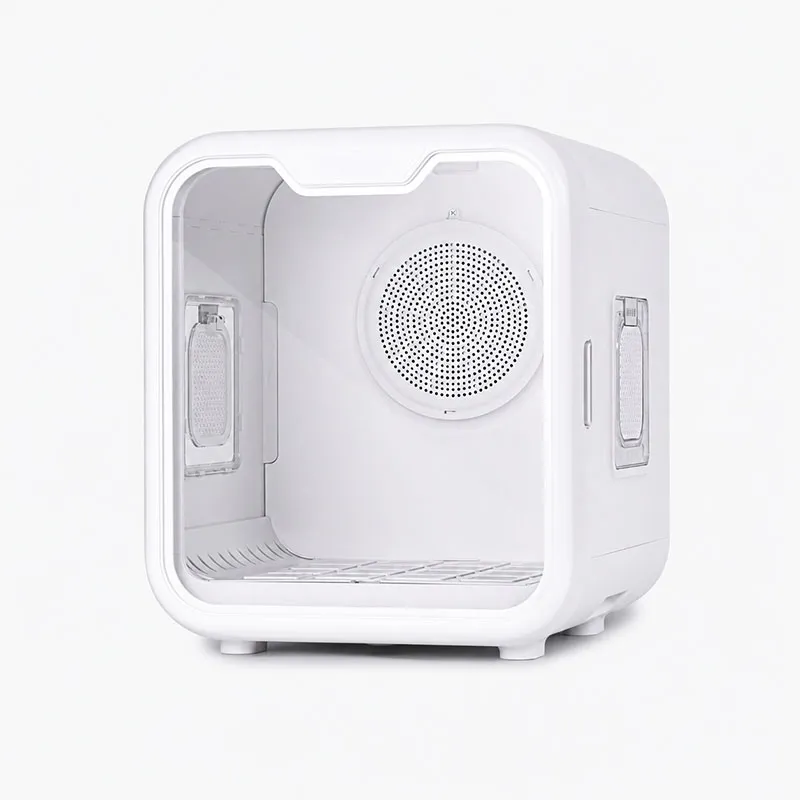
Interior chamber dimensions and maximum pet weight. The 380 × 540 × 400 mm figure is the product envelope. Usable interior space is smaller, and by how much depends on wall thickness, fan housing and door frame. “Cats and small dogs” is a positioning statement, not a limit. Ask for interior width, depth and height, plus a stated maximum animal weight.
Noise level in decibels. A dryer box that stresses the animal will be returned. This matters more in a retail environment where the buyer’s own customers are anxious pet owners.
Cycle duration and timer behavior. Whether the unit runs on a timer, runs continuously until switched off, or steps down automatically changes both the safety profile and the sales pitch.
Carton dimensions, gross weight and pieces per carton. More on why this one matters below.
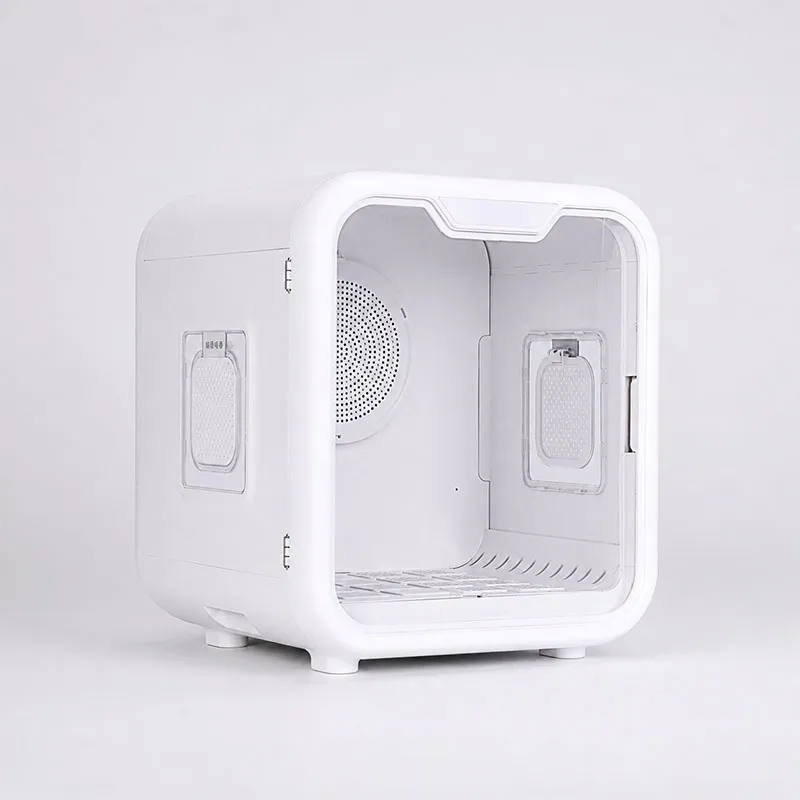
Temperature: the number that looks reassuring and is not the whole story
A 35–45 °C range reads as gentle. Human hair dryers run far hotter, so the instinct is to treat this as a solved safety question and move on.
It is not, for a specific reason: in an enclosed chamber, the temperature the thermostat reads is not necessarily the temperature at the animal’s skin, and the risk profile depends on airflow distribution and exposure duration as much as on the setpoint. A 360° airflow design exists to address exactly that — even distribution so no single surface accumulates heat. That is a design intent, not a measured guarantee.
Three questions to put to the supplier about the temperature system:
- Where is the sensor located, and what is the control tolerance? A ±2 °C tolerance and a ±8 °C tolerance are different products at the same stated range.
- At what temperature does the over-temperature shutdown trigger, and does it latch or auto-reset? A latching cutoff requires manual reset and is generally the safer behavior in a consumer product, since it forces the user to investigate rather than letting the unit cycle through a fault.
- Is the shutdown a separate thermal cutoff device or a software condition on the same sensor? If a single sensor fails, a software-only cutoff fails with it. An independent thermal fuse is the meaningful redundancy.
The anti-scalding construction and anti-hair-pinch design address the two physical injury paths that are specific to this product category: contact with a heated surface, and fur drawn into a moving part. Both are worth confirming with a physical sample rather than accepting on the spec line. Run the unit for a full cycle and touch every exterior surface, including the vents.
Compared with the salon-grade cabinet dryers sold through professional grooming equipment channels, a unit in this size and price band is built for household or small-format retail use rather than continuous commercial duty. Positioning it as salon equipment invites a duty-cycle failure you will own under warranty.
Electrical documentation: what exists and what you must request
No CE, FCC, UL, ETL or RoHS certificate number is publicly disclosed for this product. That statement is not a criticism of the product; it describes the state of published information, and it defines your first action item.
Here is how to think about which frameworks may apply.
RoHS. The EU RoHS Directive 2011/65/EU regulates restricted hazardous substances in electrical and electronic equipment. A mains-powered dryer box falls squarely inside the category of equipment RoHS is written for. If your market is the EU, a RoHS declaration is a document you need, not a nice-to-have.
FCC. The FCC’s equipment authorization requirements apply to radio-frequency devices, which must follow the applicable authorization process before being marketed or imported into the United States. Whether this unit is in scope depends on whether it contains any radio function — a Wi-Fi module, a Bluetooth control, a wireless remote. A purely mechanical control panel is a different situation from a connected version of the same cabinet. Establish which configuration you are buying before you assume the question is settled either way, and get the answer in writing.
Market-specific electrical safety. North American retail buyers will generally be asked for a mark from a recognized testing laboratory. EU buyers will be asked for a declaration of conformity with the applicable directives. These are separate documents from RoHS and separate from each other.
The practical sequence for a retailer:
- Ask which certifications the factory holds for this specific model, by model number, not by product family.
- Request scanned copies of the certificate, the test report and the declaration of conformity.
- Check that the model number and the manufacturer name on the certificate match the entity you are actually buying from.
- Check the issue date and any expiry, and whether the certificate covers the voltage version you are ordering.
- If a document does not exist, decide whether you are willing to fund testing as part of the order, and write that into the purchase agreement.
- Do not publish any certification claim on your own listing or shelf-talker until you hold the corresponding document.
That last point is worth stating plainly: writing “CE certified” or “FCC certified” on a product page without the paperwork in hand is a claim about a document, and it is the kind of claim that surfaces during a customs inspection or a marketplace compliance review rather than at a convenient moment.
Freight: the specification that quietly sets your landed cost
Take the disclosed external dimensions. A unit measuring 380 × 540 × 400 mm occupies roughly 0.082 m³ before packaging. At an MOQ of 20 units, that is approximately 1.64 m³ of product body alone, and the shipping carton adds to it.
For a product with an FOB unit price of US$86–96, that volume-to-value ratio is workable by air only in emergencies and sits comfortably in LCL ocean freight otherwise. Two consequences for a retailer:
The first is that this product ships well in a mixed container alongside lighter, bulkier goods, which is one argument for consolidating a dryer box order with other stock rather than shipping it alone. FOB, CIF and DDP arrangements are all available, and on a product of this cube the difference between them is large enough that comparing two quotes on different terms tells you nothing.
The second is that the carton has to survive the trip. A dryer box is a rigid-shell appliance with a door, a fan assembly and a control panel, all of which are damage points. Ask what internal protection the standard export carton uses, and whether a drop test has been run on the packed configuration. This is more useful than asking whether the packaging looks nice.
Retail customization: what changes and what does not
Available customization covers logo printing, silk-screen work, laser engraving, woven labels, color boxes, kraft packaging, hang tags, instruction manuals, and color and material options. For a retailer building a private-label presence, the realistic priorities on an appliance are narrower than on a soft good.
The instruction manual matters most, and it is the item retailers most often leave to the factory. On an electrical product, the manual carries the safety warnings, the maximum animal size, the cleaning procedure and the warranty terms. A poorly translated manual is a returns generator and, in some markets, a compliance problem. Commission it properly and have it reviewed in the destination-market language.
Color box printing is the second priority, because an appliance at this price point is a considered purchase that customers examine in the box.
Laser engraving and woven labels, which do a lot of work on textile and wood products, add relatively little to a molded appliance shell. Silk-screening a logo onto the panel is usually the better spend.
Two mistakes that show up after the container lands
Treating the over-temperature shutdown as a marketing feature. It is a fault-condition backstop. Building shelf copy around it implies the unit is expected to reach unsafe temperatures often enough that the protection is a selling point. Sell the temperature range and the three speed settings; treat the shutdown as the safety floor it is.
Assuming a sample from one voltage build represents the production run. If you sample a 220 V unit and order 110 V production, you have tested a different power supply, a different heating element specification and potentially a different fan. Sample the exact configuration you intend to sell, and keep the approved sample sealed and photographed as your inspection reference.
Timeline from inquiry to shelf
Published OEM lead times run 7–14 days for samples and 30–45 days for mass production after sample approval, depending on customization complexity. For an appliance, add time on both ends: documentation review before you approve the sample, and pre-shipment inspection covering appearance, materials, workmanship, packaging and order accuracy before goods leave.
A retailer planning a seasonal launch should treat the electrical documentation review as a parallel workstream starting at day one, not as a step that follows sample approval. It is the item most likely to add weeks, and it is the only one that can stop the shipment at the border.
FAQ
Q: What is the minimum order and what does it cost?
A: MOQ is 20 units at a published reference price of US$86–96, so roughly US$1,720–1,920 for a first order before freight, duties and any customization. Final pricing moves with quantity, configuration, packaging and trade term.
Q: Does the unit come with CE, UL or RoHS certification?
A: No certificate number for CE, FCC, UL, ETL or RoHS is publicly disclosed for this model. Request the specific certificates, test reports and declaration of conformity by model number before ordering, and do not make certification claims in your own listings until you hold the documents.
Q: What voltage does it run on?
A: Not stated on the public specification. Confirm the voltage and frequency version and the plug type for your market before sampling. Sample the exact voltage build you plan to sell.
Q: Is 35–45 °C safe for cats?
A: The stated range is low relative to human hair dryers, and the design includes over-temperature automatic shutdown and anti-scalding construction. Safety in practice also depends on control tolerance, airflow distribution and cycle duration, which is why the sensor location, tolerance and shutdown behavior are worth confirming with the supplier and verifying on a physical sample.
Q: What size animal fits?
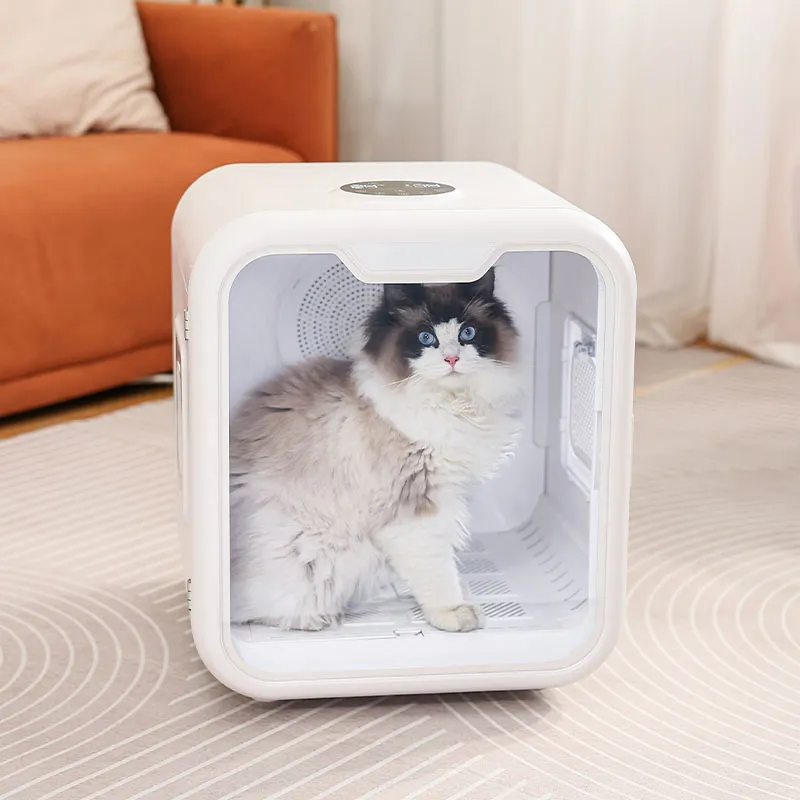
A: The product is positioned for cats and small dogs. The 380 × 540 × 400 mm figure is the external envelope, not the usable chamber. Request interior dimensions and a stated maximum animal weight, and put that limit in your shelf copy and instruction manual.
Q: Can this be used in a grooming salon?
A: It is built to a household and small-format retail specification rather than continuous commercial duty. Selling it into a salon environment without confirming the duty cycle with the manufacturer exposes you to warranty claims from heavy use.
Q: How much space does an order take up?
A: Each unit occupies roughly 0.082 m³ as a product body, so 20 units is approximately 1.64 m³ before packaging. Request carton dimensions and pieces per carton for an accurate freight calculation, and consider consolidating with other stock in a mixed shipment.
Q: Can we put our own brand on it?
A: Yes. Logo printing, silk-screen, color boxes, kraft packaging, hang tags and custom instruction manuals are all available, alongside color and material options. On an appliance, prioritize the manual and the color box over engraving and labels.
Q: How long from order to delivery?
A: Samples run 7–14 days and mass production 30–45 days after sample approval, with complex customization at the upper end. Add your own review time, the documentation review, and ocean transit to your market.










 August 22, 2026