PetNivo Tech Sourcing & Product Team | Product Sourcing & Development | Published/Updated: August 2026
Silicone dog slow feeder bowls sit in a low unit-price, mid-volume sourcing band. One disclosed model measures 20 × 20 × 4 cm at US$2.50–3.25, and feeding-line MOQs generally run 50–200 pieces. This guide covers the spec gaps, material trade-offs, customization limits and sampling timeline behind those numbers.
The figures below come from PetNivo Tech’s published product pages. They are reference bands, not quotations — final unit cost shifts with quantity, color, packaging and trade term, so confirm current numbers before building a landed-cost model.
What a “slow feeder” actually is on a spec sheet
Retail copy sells the behavior: the dog eats slower, gulps less air, and the owner feels better about mealtime. A spec sheet has to describe the geometry that produces the behavior, and that geometry is where sourcing decisions live.
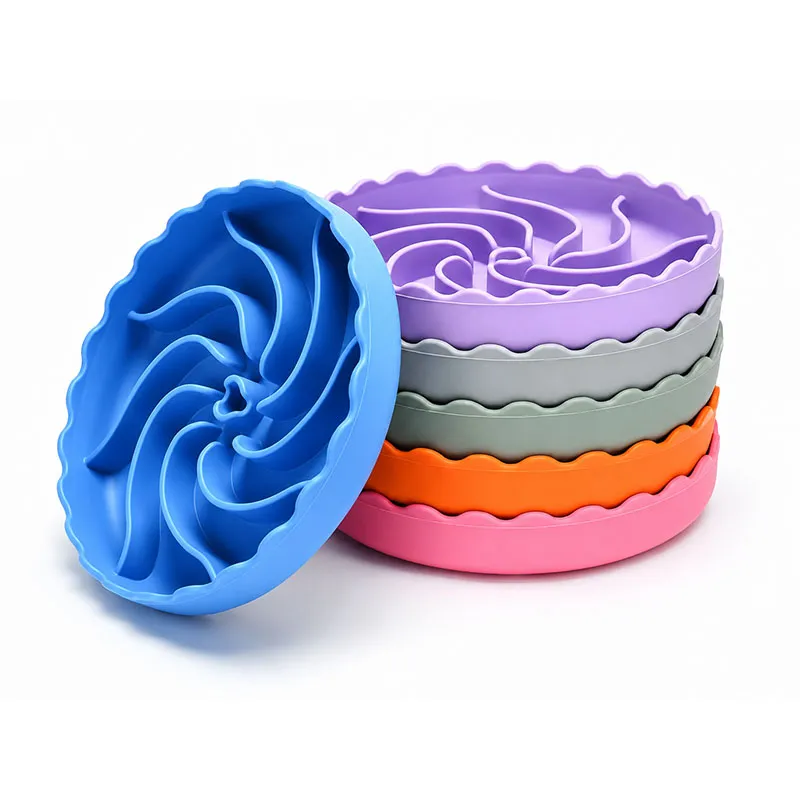
Three structural formats show up in the feeding line, and they are not interchangeable products with different skins:
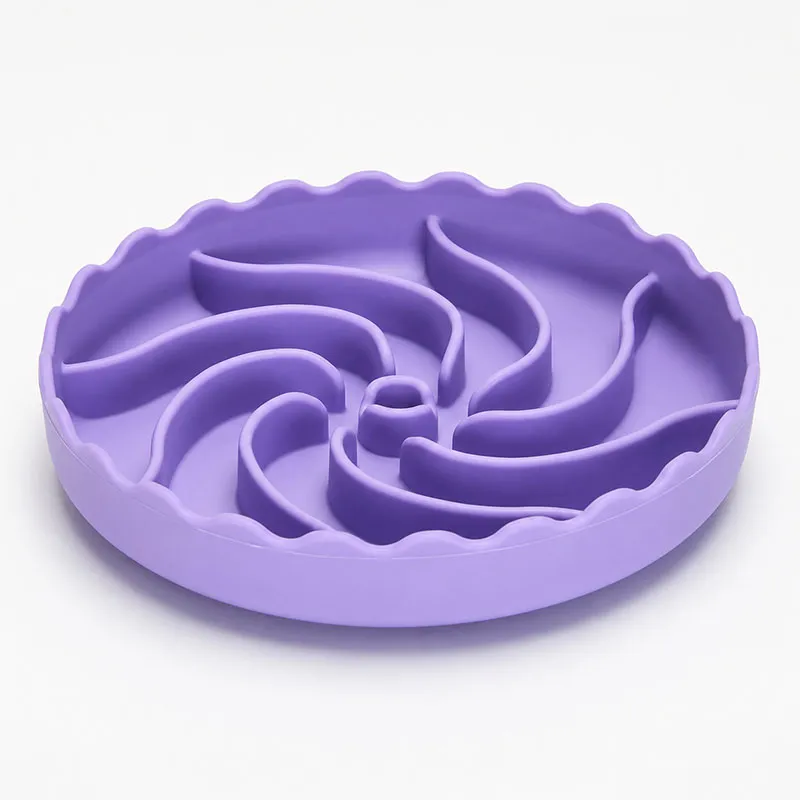
- Maze/ridge bowls. Raised internal walls divide the bowl floor into channels. Food sits in the channels; the dog works around the ridges. The silicone version is molded as a single piece, so ridge height and channel width are fixed at the mold, not adjustable per order.
- Rolling-ball bowls. A loose or captive ball sits in the feeding well and shifts as the dog eats. Slowing comes from the moving obstacle rather than fixed walls.
- Lick mats and lick bowls. A textured surface holds wet food, paste or yogurt in a thin layer. These target licking duration, not kibble portioning, and belong in a different merchandising slot than a dry-food bowl.
For an e-commerce brand building a range, the practical consequence: a maze bowl and a lick mat are two SKUs solving two problems. Listing them as “slow feeder, style A / style B” tends to produce returns from buyers who expected one and received the other.
Spec sheet: what is disclosed and what you have to ask for
| Item |
Eco Friendly Silicone Dog Slow Eating Bowl |
Dog Anti-Slip Slow Eating Bowl |
Dog Lick / Slow Feeder Bowl with Rolling Ball |
Silicone Dog Lick Mat |
| Primary material |
Silicone |
Food-grade PP |
Silicone (lick/feeder format) |
Silicone |
| Disclosed dimensions |
20 × 20 × 4 cm |
Not disclosed — request spec sheet |
Not disclosed — request spec sheet |
Not disclosed — request spec sheet |
| Slowing mechanism |
Molded maze/ridge |
Molded maze + anti-slip base |
Rolling ball in feeding well |
Textured licking surface |
| Website reference price |
US$2.50–3.25 |
Not published — request quotation |
US$2.50–3.50 |
US$1.35–2.80 |
| Typical feeding-line MOQ |
~50–200 pcs, model and customization dependent |
~50–200 pcs |
~50–200 pcs |
~50–200 pcs |
| Certificate numbers on file |
Not publicly disclosed |
Not publicly disclosed |
Not publicly disclosed |
Not publicly disclosed |
Two columns in that table are mostly blanks, and that is the honest state of the published data. Compared with the retail listings and manufacturer catalog pages that fill most of this category’s search results, a buyer-side spec sheet has to carry the fields those pages skip: bowl depth, ridge height, base diameter, net weight, Shore hardness of the silicone, and carton dimensions. None of those are marketing claims. All of them change your freight math or your listing copy.
Three fields worth requesting in writing before you sample:
- Ridge height and channel width in millimeters. These determine which kibble sizes the bowl actually slows.
- Net weight per piece. Silicone is denser than PP at similar wall thickness; a bowl that costs the same at FOB can cost more per unit on air freight or on a weight-based last-mile rate.
- Nesting depth and pieces per carton. A 4 cm-deep bowl that nests to 1.5 cm stacked ships very differently from one that does not nest at all.
Silicone versus PP: the trade-off that decides the price band
Both materials are in the feeding line, and both have a defensible case. Sourcing teams get into trouble by treating “silicone” as an automatic upgrade.
Where silicone earns its cost. It flexes rather than fracturing, which matters for a product that gets dropped, stepped on and thrown into a dishwasher rack. Compared with the rigid injection-molded plastic slow feeders that occupy the same shelf price band, silicone does not develop stress cracks at the ridge bases after repeated impact, and it holds less residual odor after wet-food use. For a brand competing on review scores rather than price, those two failure modes are the ones that generate one-star reviews.
Where PP wins. It is cheaper to tool and cheaper to run, it holds a rigid shape so the bowl does not deform when a large dog pushes against it, and it accepts a wider range of surface printing methods. The PetNivo anti-slip PP bowl is built around food-grade PP with an anti-slip base — a rigid bowl needs that base, whereas a silicone bowl’s own weight and surface friction do much of that work.
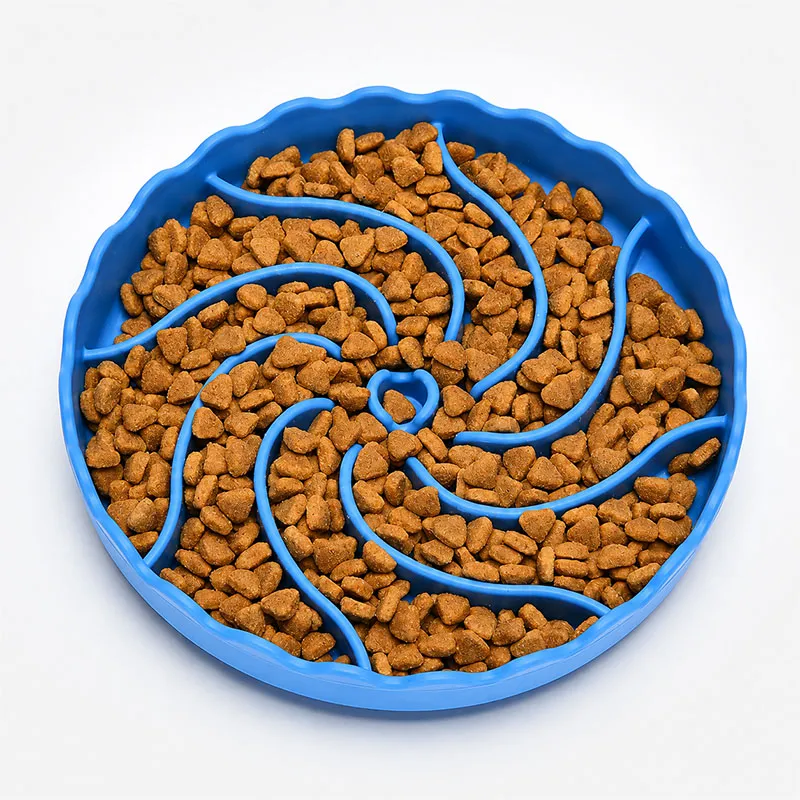
The edge case most buyers miss. Slow feeder performance is a relationship between channel width and kibble diameter, not a property of the bowl alone. When channel width sits close to or below the diameter of the kibble the end customer feeds, large pieces wedge into the grooves instead of flowing out. The dog stops eating; the owner blames the bowl. If your customer base skews toward large-breed dogs on large kibble, request the channel dimensions and test with the actual kibble size before you commit to the mold. This is also worth putting in your own listing copy as a kibble-size recommendation — it costs nothing and it deflects a predictable category of return.
The reverse edge case: a very soft, very flexible silicone bowl can be picked up and carried off by a determined dog, which a weighted rigid bowl cannot. Softness is not free.

MOQ: what changes at each tier
Feeding products in this line generally start around 50–200 pieces per model, with the exact figure depending on the model and how much customization is attached. That range is wide because MOQ is really three separate thresholds bundled under one number.
Stock-spec MOQ is the floor: existing mold, existing color, no branding. This is where trial orders and mixed-container purchasing sit, and it is the lowest number a supplier will quote.
Custom-color MOQ is higher, because it requires a dedicated material batch. Color matching to a Pantone reference raises it further.
Custom-mold MOQ is a different conversation entirely, since it carries tooling cost and amortization. A new maze geometry means a new mold, not a modified order.
For an e-commerce brand testing a category, the useful sequencing is to run stock-spec first with custom packaging, prove the sell-through, and only then commit to color or mold changes. Packaging customization is the cheapest way to make a stock product look proprietary on an unboxing video.
PetNivo supports mixed-product ordering and trial-order arrangements alongside larger OEM programs, which is what makes the stock-first sequence workable without committing a full container to one SKU.
Price bands and what moves them
Published reference prices across the silicone feeding group:
| Product |
Website reference price |
| Dog Lick / Slow Feeder Bowl with Rolling Ball |
US$2.50–3.50 |
| Eco Friendly Silicone Dog Slow Eating Bowl |
US$2.50–3.25 |
| Silicone Dog Lick Mat |
US$1.35–2.80 |
The spread inside each band — roughly 30% on the silicone bowls — is where quantity, color and packaging live. A few things to hold in mind when you model landed cost:
Trade term does most of the work. FOB, CIF and DDP arrangements are all available, and the gap between an FOB unit price and a DDP unit price on a light, bulky product like a bowl is large enough that comparing two suppliers’ quotes on different terms is meaningless. Fix the term first, then compare.
Retail packaging is the second lever. A color box on a US$2.80 bowl is a meaningful percentage of unit cost, while a hang tag or a woven label is not. If margin is tight, kraft packaging with a printed sleeve usually reads as premium at a fraction of the color-box cost.
Prices published on product pages are reference figures, not fixed quotations, and they move with specification and order conditions. Treat them as a band for feasibility screening rather than a number to put in a business plan.
Sampling to production: the timeline you are actually buying
Published OEM lead times are 7–14 days for sample production and 30–45 days for mass production after sample approval, depending on customization complexity. Sequenced against a launch date, that looks like this:
- Send the brief. Kibble size range, target retail price, destination market, packaging direction, and whether you need a stock mold or a new one.
- Receive the spec sheet and quotation. Check that dimensions, net weight and carton data are filled in. Blanks here become surprises later.
- Approve the sample brief and pay the sample cost. Confirm color reference and branding method in the same message, not separately.
- Sample production: 7–14 days. Add shipping time to your own market on top of this. A sample sent by express is still several days in transit.
- Physical sample review. Test with the actual kibble your customers feed. Check the base grip on a hard floor and after a wash cycle. Photograph everything you approve.
- Written sample approval. This is the reference point for any later quality dispute, so approve in writing against a photographed sample rather than verbally.
- Mass production: 30–45 days. Complex customization sits at the upper end of that range.
- Pre-shipment inspection. Appearance, materials, workmanship, packaging and order accuracy are checked before the goods leave.
Working backward from a Q4 listing date, a new custom-color SKU with retail packaging needs to start in the second quarter, not the third. The common planning error is budgeting only for the 30–45 day production window and treating sampling, approval and ocean transit as rounding errors.
Two misconceptions worth correcting internally
“Slow feeder” is not a certification or a tested claim. No standardized test defines how much slower a dog must eat for a bowl to carry the label. Marketing claims about eating-speed reduction percentages need a source, and if a supplier offers a number without a test report behind it, do not put it on your listing.
A lower FOB price does not mean a lower landed cost. Bowls are light and bulky. A bowl that does not nest can occupy substantially more container volume than one that does, and on a US$2.80 product, freight cube is a larger share of landed cost than most spreadsheets assume. Ask for carton dimensions and pieces per carton at the quotation stage, not after you have chosen the supplier.
Where this category sits in the broader market
Some context for range planning: the American Pet Products Association reports US pet industry expenditure of US$158 billion in 2025 across 95 million pet-owning households. Feeding products are a repeat-purchase, low-ticket entry point into that spend, which is why the category is crowded at retail and why differentiation has to come from specification and presentation rather than from the product concept itself.
That is the practical argument for spending your customization budget on packaging and listing accuracy before spending it on a new mold.
FAQ
Q: What is the realistic minimum order for a silicone slow feeder bowl with our logo on it?
A: Feeding-line MOQs generally run 50–200 pieces depending on model and customization. A logo applied to a stock-color product sits at the lower end of that range; a custom color or a new mold moves it upward. Confirm the specific figure per model, since it is quoted per item rather than per category.
Q: Can we get certificate numbers for FDA or BRC compliance?
A: The published product pages reference standards but do not disclose certificate numbers, testing report numbers or issuing bodies. Request product-specific documentation directly and make it a condition of the purchase order. Until you hold that paperwork, do not use “certified” language in listing copy.
Q: Silicone or PP for a first slow feeder SKU?
A: If your customer base leans toward large or destructive dogs and your reviews matter more than your unit cost, silicone’s resistance to cracking and lower odor retention justify the price band. If you are competing on price in a crowded listing, food-grade PP with an anti-slip base does the same job at a lower cost and holds a rigid shape better.
Q: How long from first inquiry to goods leaving the factory?
A: Roughly 7–14 days for samples, then 30–45 days for mass production after you approve the sample, plus your own review and shipping time. Budget conservatively for the sample review step, which is the phase buyers most often underestimate.
Q: Do slow feeder bowls work with every kibble size?
A: No, and this is the most common source of complaints. Channel width has to exceed the kibble diameter for food to release properly. Request channel dimensions in millimeters and test with the actual kibble before committing.
Q: What is the cheapest way to make a stock product look proprietary?
A: Custom retail packaging. Logo printing, laser engraving, woven labels, kraft packaging, color boxes, hang tags and printed instruction manuals are all available, and packaging changes the unboxing experience without touching the mold or raising the MOQ tier.
Next step for a buying team: build a one-page spec request covering channel width, net weight, nesting depth and carton cube, and send it to every supplier on your shortlist before requesting quotations. Comparing filled-in spec sheets is faster than comparing samples, and it surfaces the suppliers who do not actually have the data.
Not covered here: multi-SKU container consolidation across feeding and hydration products, and how bowl selection interacts with elevated stand and gravity feeder assortments. Both are worth a separate look if you are planning a full feeding range rather than a single SKU.










 August 19, 2026