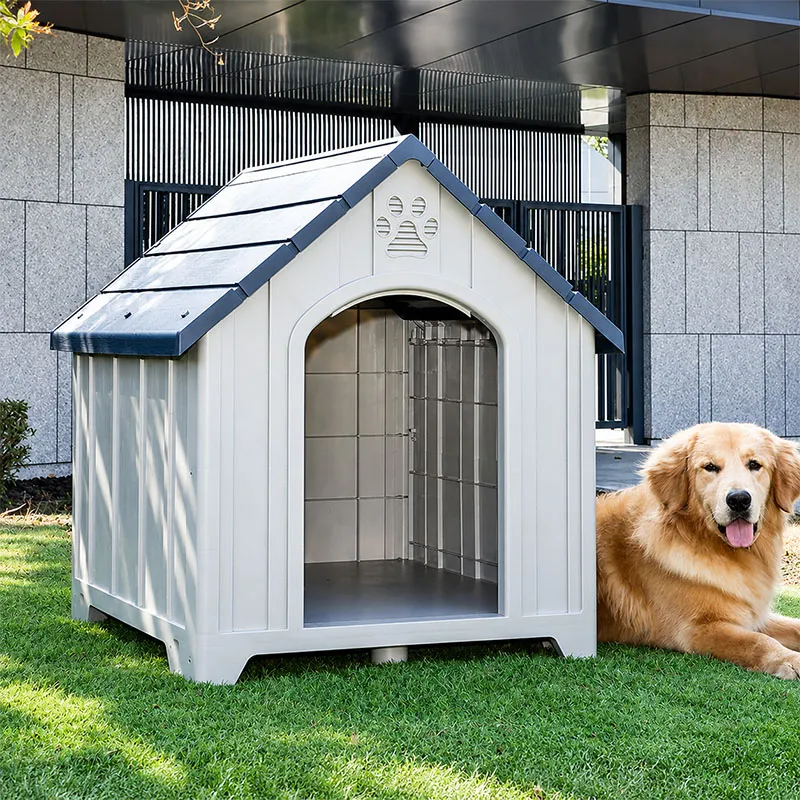
Before ordering outdoor plastic dog houses, verify five things on a physical sample: measured wall thickness, UV stabilization in writing, floor drainage under a water test, assembly time, and packed carton volume.
Why a plastic kennel is a freight problem before it is a product problem
The end market is not small. The American Pet Products Association (APPA) reports 95 million pet-owning households in the U.S. But a distributor’s margin on an outdoor kennel is mostly set at the factory door, by two decisions buyers often leave to the supplier: how the house is packed, and how much resin goes into the walls.
Compared with common wooden dog houses, plastic units need no sealing against rot and can be hosed clean. The trade-off is that plastic is sensitive to sunlight and cold, a thin wall flexes where a wood panel would not, and the product’s low weight per cubic meter makes it expensive to move.
This tutorial is written for regional distributors buying in container or mixed-container quantities. Each step below ends with a pass condition so you can tick it off or send it back.
The 9-step pre-order verification checklist
Step 1: Fix your size grid before you ask for a quote
“Small” and “large” mean different things to different factories. Send your own grid and ask the supplier to fill every field for every size:
1.External length × width × height
2.Internal floor length × width
3.Door opening height and width
4.Recommended dog weight range
5.How that weight recommendation was set (load test, or estimate)
Door height is the field most often missing, and it is the one that decides whether a large-breed owner returns the product. A house with a generous floor and a low door still fails for a tall dog.
Step 2: Get the resin type and recycled content in writing
Outdoor plastic dog houses are typically made from PP, HDPE or ABS. Ask which one, and whether the resin is virgin, recycled or a blend, with an approximate share. Recycled content is not automatically a defect, but it can shift color between batches and change how the wall behaves under impact, so you want to know before you approve the color sample rather than after.
Step 3: Measure wall thickness at more than one point
A single “wall thickness” figure on a spec sheet tells you little, because molded parts are rarely uniform. Corners and deep sections often run thinner than flat panels.
On the sample, use a caliper (or an ultrasonic gauge for double-wall parts) and record thickness at:
1.Roof ridge
2.Roof edge or eave
3.Center of each side wall
4.Wall corners
5.Floor center
6.Around the door frame and any clip or bolt points
Then press the center of a side wall with your palm. Note how far it moves. You are not looking for a lab result here; you are building a reference so that the mass-production units can be compared against the same points later.
Pass if: the supplier states a nominal thickness and tolerance in writing, and the sample readings fall inside it at every point.
Step 4: Turn “UV-resistant” into a written requirement
Almost every listing for an outdoor plastic dog house says UV-resistant. The phrase only means something if a UV stabilizer is actually compounded into the resin. Ask:
- Is a UV stabilizer or UV masterbatch added? At what loading?
- Is there an accelerated weathering lab report for this resin and color? If yes, which test method, how many hours, and what was measured (color change, cracking, impact strength after exposure)?
Color matters here as well. Dark colors absorb more heat in direct sun, which affects both comfort inside the house and how quickly the surface fades.
Pass if: the PO names the UV stabilizer requirement, and you hold a retained sample.
Step 5: Run a water test on the assembled sample
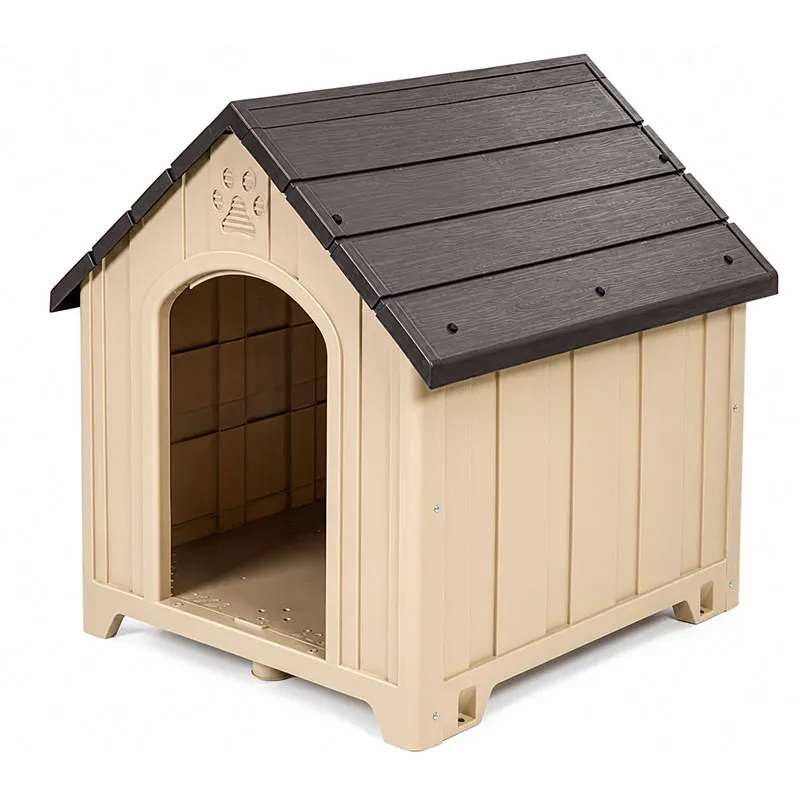
“Waterproof” in a product name is a description, not a test result. Set the assembled sample on level ground and run a garden hose over the roof and seams for about five minutes, aimed the way wind-driven rain would hit it.
Then check:
- Water inside along roof and wall seams
- Water pooling on the floor
- Whether the floor is raised off the ground or sits flat (a flat floor collects condensation underneath)
- Drain holes or a floor slope, if the design has them
- Whether the door lip stops runoff from entering
Step 6: Ask exactly what “insulated” means
Buyers searching “plastic insulated dog house” expect something warmer than a single plastic shell. Ask the supplier which construction the model uses:
| Construction |
What to ask for |
Listing risk if unverified |
| Single wall |
Thickness readings from Step 3 |
Calling it “insulated” invites returns in cold markets |
| Double wall with air gap |
Cross-section photo or cut sample |
Moderate; describe the structure, not a temperature |
| Foam-filled double wall |
Foam type and fill method |
Lowest, but still no thermal rating unless tested |
Step 7: Time one person assembling the sample
Unbox the sample as your customer would and have one person assemble it using only the included manual. Record:
1.Total minutes
2.Number of parts and fasteners
3.Tools needed (none, a screwdriver, or bolts and a wrench)
4.Any clip that needed force or did not seat on the first try
If your retail customers display assembled units and then sell them boxed, repeat the assembly and disassembly two more times and check whether the clips still lock. Snap-fit designs that loosen after a few cycles generate “parts missing” and “wobbly” complaints.
The manual is part of this check. PetNivo’s OEM options include custom instruction manuals, so a manual in your market’s language can be specified at the order stage.
Pass if: assembly is completed within the time you set as acceptable for your customer, with no forced clips.
Step 8: Calculate packed volume and freight per unit
This is the step that separates a profitable kennel from one that only looks cheap on the quote. Ask for:
- Carton length × width × height
- Gross weight per carton
- Units per carton
- Packing method: assembled, knocked-down (flat), or nested
Then work out freight per unit:
Cartons per container (upper bound) = container internal volume ÷ carton volume Freight per unit = container freight cost ÷ (cartons × units per carton)
Nominal internal volumes are roughly 33 m³ for a 20GP, 67 m³ for a 40GP and 76 m³ for a 40HQ. Real loading always fits fewer cartons than the pure division suggests, so use your forwarder’s stuffing plan for the final number.
Worked example: a kennel packed flat in a 0.20 m³ carton versus the same kennel packed assembled in a 0.60 m³ carton, one unit per carton, in a 40HQ.
| Packing method |
Carton volume |
Max cartons in 76 m³ (upper bound) |
Freight per unit at container cost C |
| Knocked-down (flat) |
0.20 m³ |
380 |
C ÷ 380 |
| Assembled |
0.60 m³ |
126 |
C ÷ 126 |
Same product, same container price, and freight per unit is three times higher when shipped assembled. For LCL shipments the logic is the same: ocean LCL is charged on the greater of weight or volume, and a plastic kennel will almost always be billed on volume.
Two levers help. First, specify knocked-down or nested packing at the quotation stage; it can change the mold and carton design, so it is hard to add later. Second, PetNivo supports mixed-product orders, so dense items (bowls, litter boxes) can share the container with kennels and lower the average freight cost per unit across the order.
Step 9: Write the checks into the PO and the pre-shipment inspection
Everything verified in Steps 1–8 only protects you if it is written into the purchase order and checked again on mass-production goods. PetNivo’s pre-shipment QC covers appearance, materials, workmanship, packaging and order accuracy. For outdoor plastic kennels, add these kennel-specific points to the inspection brief:
- Wall thickness spot checks at the Step 3 points
- Color match against the approved and retained sample
- One random-unit assembly with the Step 7 timing
- Carton dimensions and gross weight against the quoted figures
- Carton markings and size labels matching the size grid
FAQ
What wall thickness should an outdoor plastic dog house have?
There is no single correct number in PetNivo’s published data for this product. Set a nominal thickness and tolerance with the supplier, measure the approved sample at six or more points, and check mass-production units against those same points.
Are plastic dog houses insulated?
Only if the wall construction makes them so. Single-wall shells provide shelter from rain and wind but little insulation; double-wall or foam-filled designs do more. Ask for a cross-section photo before using the word “insulated” on a listing.
How should a distributor choose between small and large plastic dog house sizes?
Start from door opening height and internal floor dimensions, not the size label. Match those to the breeds common in your territory, and confirm how the supplier’s recommended weight range was determined.
What is the MOQ and price for PetNivo’s Outdoor Waterproof Plastic Dog House?
Neither has been published. Request a quotation with your size grid, packing method and destination. Mixed-product orders are supported, which can help if you want to trial kennels alongside other categories.










 October 30, 2026