Buying the wrong pet carrier can ruin a trip before it starts. A box that is too small, poorly ventilated, weak, or rejected by the airline can create stress for both owner and animal. The solution is to match the carrier, pet, route, and airline rules before travel.
A plastic hard-shell pet air travel carrier should give a dog or cat enough room to stand, turn, sit, and lie naturally while providing secure fasteners, ventilation, a leak-resistant floor, and a strong door. There is no universal “airline-approved” carrier, so travelers must always confirm the current airline and destination requirements before departure.
What Is a Plastic Hard-Shell Pet Carrier?
A plastic hard-shell pet carrier is a rigid transport enclosure designed to move a dog or cat safely between locations. Most models use a molded plastic upper and lower shell combined with a metal or reinforced door, ventilation openings, secure fasteners, and one or more carrying handles.
Depending on the design and local rules, a hard-sided pet product may serve as a travel crate, home carrier, veterinary transport box, road-trip carrier, or air transport container.
The main difference from a fabric travel bag is structure. A rigid shell keeps its shape when pressure is applied from the outside. That can be useful during handling and transport, especially when a carrier may be moved by airport or cargo personnel.
Typical product features include:
- Molded plastic top and base
- Ventilation openings
- Front metal door
- Secure door latch
- Carrying handle
- Leak-resistant floor
- Interior attachment points where appropriate
- Removable upper shell
- Metal bolts or other secure shell fasteners
- Optional wheels on larger models
- Feeding and water accessories on transport models
For retailers, the category can cover both a small pet carrier for short trips and a larger pet transport crate intended for more demanding travel situations.
The terms also overlap in online searches. Shoppers may type:
- Pet carrier
- Dog carrier
- Cat carrier
- Pet travel carrier
- Travel pet carrier
- Carrier for pets
- Carrier for cats
- Cat travel carrier
- Dog travel carrier
- Hard-sided pet carrier
- Plastic pet carriers
- Airline travel crate
A strong product page should tell the customer exactly what the specific model is designed for rather than relying on a broad keyword alone.

Is an Airline Approved Pet Carrier Really Approved by Every Airline?
No. This is one of the most important points for both consumers and pet-product sellers.
The phrase airline approved pet carrier is widely used in search results, but it can create the wrong impression. IATA states that it does not certify, approve, sell, or endorse individual commercial dog or cat containers. Instead, IATA publishes container requirements and guidance for live-animal transport.
Airlines may then apply those standards alongside their own operating rules.
That means a product described as an airline approved pet carrier may still be rejected if:
- It is too large for the airline
- The pet cannot stand naturally
- Ventilation is inadequate
- Fasteners do not meet requirements
- The route does not accept pets
- The aircraft has different restrictions
- The destination has additional rules
- The animal type or breed is restricted
The correct question is not simply:
“Is this carrier airline approved?”
A better question is:
“Does this carrier meet the requirements of my specific airline, route, aircraft, destination, and type of pet?”
IATA’s current guidance advises passengers to contact their chosen airline and confirm that it will accept the animal on the planned flight. Only small dogs and cats may be allowed in the cabin, and individual airlines can apply more restrictive conditions.
What does IATA require from pet containers?
For air transport, the required design depends on how and where the animal travels. IATA Container Requirement 1 for dogs and cats includes detailed rules on construction, ventilation, flooring, doors, dimensions, and fasteners.
For rigid plastic transport containers, current IATA guidance states that when the top and bottom parts are separate, they should be securely fastened together; plastic clips alone should not be the only connection system. The guidance also specifies a solid leak-proof floor and ventilation requirements.
This is especially important for B2B buyers.
Rather than printing “approved by all airlines”, better packaging language is:
“Designed for pet travel. Always confirm carrier size, construction, route, and current requirements directly with your airline before flying.”
This is more accurate and builds greater trust.
Searches for the best airline-approved pet carriers show strong buying intent, but the content behind that phrase should explain the limitation rather than promise universal acceptance.
How Do You Choose the Right Pet Carrier Size?
Size is not just about the animal fitting through the door.
The pet should have enough internal space to:
- Stand normally
- Sit naturally
- Turn around
- Lie down in a natural position
IATA publishes a measurement system for dogs and cats traveling in transport containers.
The measurements include:
- A: Nose to base of tail
- B: Ground to elbow
- C: Width across shoulders or widest point
- D: Natural standing height to the top of the head or ears
For a single animal, IATA gives the following general calculation:
Minimum Internal Length = A + ½ B
Minimum Internal Width = C × 2
Minimum Internal Height = D + bedding allowance
IATA also notes that short-nosed breeds may require additional space.
Pet carrier sizing checklist
| Measurement |
What to Check |
| Internal length |
Pet can lie naturally |
| Internal width |
Pet can turn around |
| Internal height |
Ears or head do not press against roof |
| Door width |
Pet can enter without forcing |
| Floor space |
Animal can change position |
| Carrier weight |
Suitable for handling requirements |
| Total pet + carrier weight |
Within airline limit where applicable |
A small dog may fit a compact carrier, but weight alone does not determine suitability. A long-bodied dog may need more length than another animal of the same weight.
The same applies when choosing a cat carrier. Some cats prefer curling tightly at home, but air transportation standards still require enough space for normal posture and movement.
For e-commerce sellers, publish internal dimensions as well as external dimensions. Buyers cannot calculate real pet space from outside measurements alone because shell walls, doors, handles, and curved roofs reduce usable volume.

Hard-Sided or Soft-Sided Pet Carrier: Which Is Better?
Both products have a role.
A rigid plastic carrier keeps a defined shape. A soft-sided pet carrier uses textile walls, mesh panels, padding, and flexible support.
Hard-sided vs. soft-sided carriers
| Feature |
Hard-Sided Carrier |
Soft-Sided Carrier |
| Structure |
Rigid |
Flexible |
| External compression |
Low |
Higher |
| Cleaning |
Usually easy to wipe |
Depends on textile |
| Storage |
Takes more space |
Often collapsible |
| Under-seat flexibility |
Lower |
Often better |
| Cargo-style use |
Common |
Usually more limited |
| Door design |
Metal or rigid |
Zipper and mesh |
| Large sizes |
Common |
Less common |
| Protection from impact |
Better rigid structure |
Less rigid |
An airline approved soft-sided product is commonly searched because soft carriers can sometimes fit under aircraft seats more easily. However, compression should never block the ventilation openings or reduce the animal’s usable space.
IATA specifically warns that soft-sided containers may compress under the seat, potentially reducing ventilation if openings are blocked.
A hard shell may make a stronger choice for air travel when the pet is traveling in a transport situation that requires rigid construction. But a rigid design is not automatically accepted for in-cabin use.
That distinction matters.
What about expandable carriers?
An expandable pet carrier or side expandable pet carrier gives the animal more resting room when the expansion section is open.
These products can be useful during:
- Airport waiting
- Hotel stays
- Car stops
- Home use
- Long waiting periods
However, an expansion panel should not be opened unless the environment allows it safely.
An expandable model also should not be assumed to meet under-seat requirements when expanded.
Likewise, collapsible carriers and collapsible travel products focus on storage efficiency, while rigid transport crates focus more on structural protection.
Retailers may benefit from carrying both product families.
What Features Matter Most for Pet Air Travel?
A good pet travel product should be evaluated as a complete transport system.
Five areas matter most:
1. Ventilation
The animal needs adequate airflow.
IATA’s 2026 Container Requirement 1 states that the total ventilated area for relevant rigid containers must be at least 16% of the total area of the four sides, with additional ventilation allowed in certain areas.
The openings should also prevent paws, noses, or other body parts from becoming trapped.
2. Secure construction
The upper and lower shells should remain connected during normal handling.
For certain rigid plastic containers, IATA recommends metal nuts and bolts rather than relying only on plastic clips.
B2B buyers should inspect:
- Bolt count
- Hole alignment
- Plastic thickness
- Edge strength
- Handle attachment
- Door frame stiffness
- Locking-pin engagement
3. Solid floor
The floor should remain stable and contain normal waste or spilled water.
A removable absorbent pad can improve hygiene, but it should not slide into a position that blocks the animal or door.
4. Strong door
The door should resist bending and accidental opening.
Metal-door designs are common in a hard-sided plastic pet carrier. Check the weld points, hinges, latch, locking pins, and gap dimensions.
5. Safe handling
Handles should allow handlers to lift the box without placing their fingers near the animal.
USDA guidance for pet air travel also recommends checking kennel size, construction quality, ventilation, secure fasteners, flooring, handles, and access to food and water where required.

Can a Hard-Shell Carrier Be Used as an In-Cabin Pet Carrier?
Sometimes, but not automatically.
For an in-cabin pet, the container normally must fit in the space specified by the airline, often beneath the seat in front of the passenger.
Hard shells do not compress. This makes precise dimensions especially important.
A carrier that is just one or two centimeters too high may not fit the required space on a particular aircraft.
IATA notes that only very small dogs or cats and their containers will fit under many passenger seats. Airlines may also impose their own restrictions.
Therefore:
Never advertise one fixed hard-shell size as a universal in-cabin pet carrier.
Instead, publish the external dimensions clearly and tell customers to confirm the current allowance.
In-cabin vs. transport crate
| Factor |
In-Cabin Carrier |
Larger Travel Crate |
| Pet size |
Usually small |
Small to large |
| Placement |
Cabin area allowed by airline |
Hold/cargo according to airline |
| Size restriction |
Very strict |
Airline and route dependent |
| Soft-sided option |
Common |
Often not appropriate |
| Hard-sided option |
Sometimes |
Common |
| Owner access |
Nearby, but carrier usually remains closed |
No access during flight |
| Airline confirmation |
Required |
Required |
A small pet or cat may be a better candidate for in-cabin travel than a large pet, but individual airline rules still decide.
When choosing an in-cabin pet carrier, the traveler should compare the carrier’s external dimensions with the current airline limit before booking.
How Should You Prepare a Dog or Cat for Air Travel?
The right carrier is only one part of the journey.
IATA recommends introducing the animal to its travel container well before departure so the enclosure becomes familiar.
Start slowly.
Place the carrier in the home with the door open. Add familiar bedding or a safe item with the pet’s scent. Let the animal explore without being forced inside.
Then move through short stages:
- Let the animal enter voluntarily.
- Feed small treats inside.
- Close the door briefly.
- Extend the closed period.
- Carry the box short distances.
- Practice short car travel trips.
- Return home and let the animal rest.
The goal is to give your pet time to build a normal association with the carrier.
Before the flight
When you travel with your pet, confirm:
- Airline reservation
- Route restrictions
- Carrier dimensions
- Destination regulations
- Health documentation
- Vaccination requirements
- Feeding instructions
- Identification details
- Emergency contact information
USDA notes that pet travel documentation requirements can vary by destination, and international preparation may require veterinary involvement well before departure.
Travelers should also remember that requirements can change.
The correct plan for cat travel from one country may not match dog travel to another.
Likewise, the documents required this year may not be identical next year.
Sedation and air travel
Do not sedate an animal simply to make travel easier without veterinary advice.
IATA advises against routine sedation or tranquilization for dogs and cats flying in cabin because the medication may affect how animals respond to transportation stress. If medication is medically required, it should be under veterinary direction and disclosed as required.
A comfortable carrier helps. Training helps. Planning helps.
No box can make every animal suitable to fly.

Can the Same Pet Carrier Be Used for Car Travel?
Yes, many people use a rigid carrier during car travel, veterinary visits, and home transport.
However, air-travel suitability and automotive crash safety are different issues.
A product that meets an airline’s container rules is not automatically crash tested for a vehicle.
The Center for Pet Safety runs independent programs for road-travel products, including pet travel carriers and travel crates. Its certification program evaluates products against separate vehicle-safety standards.
Therefore, do not combine claims such as:
“Airline compliant”
“Crash tested”
“Car seat certified”
“Center for Pet Safety certified”
unless each claim is supported separately.
A rigid box used in a vehicle should be positioned and secured according to the carrier and vehicle instructions.
The carrier should not slide freely across the rear seat or cargo area.
A normal car seat attachment, seat belt loop, luggage strap, or crate anchoring system should only be used in the way it was designed.
For retailers, a useful product distinction is:
Air travel carrier: focused on animal transport requirements.
Automotive travel crate: designed and potentially tested for road travel.
Car seat cover: protects upholstery but does not restrain the animal.
These are different categories.
What Should B2B Buyers Inspect Before Sourcing Plastic Pet Carriers?
A sample that looks attractive in a photo may still have problems in production.
At PetNivo Tech, we recommend that importers and private-label brands inspect the complete product from raw material through packaging.
Plastic shell
Check:
- Resin type
- Wall thickness
- Reinforcement ribs
- Surface finish
- Odor
- Color consistency
- Impact resistance requirements
- Mold marks
- Edge quality
- Door
Review:
- Metal thickness
- Wire spacing
- Weld quality
- Corrosion protection
- Hinge strength
- Lock function
- Pin depth
- Sharp edges
- Fasteners
Check whether the top and lower shells use:
- Bolts and nuts
- Screws
- Clips
- Mixed fastening systems
For products intended for serious pet transport, buyers should compare the selected construction against the applicable airline and regulatory requirements.
Ventilation
Do not evaluate ventilation by appearance alone.
Check:
- Total opening area
- Opening size
- Number of ventilated sides
- Whether accessories block holes
- Whether labels could cover openings
- Packaging
A rigid carrier is mostly empty volume, which can create high freight costs.
Important carton questions include:
- Can shells nest during shipping?
- Can the door ship inside the lower shell?
- Can handles be packed separately?
- How many units fit per carton?
- Are screws packed in a labeled bag?
- Are instructions easy to find?
- Is the shell protected from scratching?
B2B sourcing checklist
| Item |
What the Buyer Should Confirm |
| Product dimensions |
Internal and external |
| Pet size positioning |
Supported by measurements |
| Plastic material |
Declared specification |
| Door construction |
Strength and finish |
| Ventilation |
Intended travel requirement |
| Fasteners |
Type and quantity |
| Handle |
Load and attachment |
| Wheels |
Fixed or removable |
| Packaging |
Carton and nesting method |
| Instructions |
Assembly and travel warning |
| Logo |
Printing, sticker, or molded option |
| Claim review |
No unsupported airline approval |
PetNivo works as a sourcing and OEM/private-label partner rather than assuming every model comes from one single factory.
We can help buyers compare manufacturing options, review samples, coordinate packaging, follow production, and plan quality-control checkpoints.
Which Pet Travel Carrier Styles Should Retailers Stock?
Retailers do not need to choose only one carrier.
Different customers search for different ways to transport a pet.
A balanced travel assortment may include:
Hard-shell plastic carrier
Best for buyers who want:
- Rigid construction
- Easy cleaning
- Veterinary trips
- Home transport
- Selected air transport applications
- Soft-sided carrier
Often popular with customers looking for:
- Lightweight construction
- Shoulder carrying
- Under-seat flexibility
- Short trips
- Small dogs and cats
- Backpack pet carrier
A backpack pet carrier can suit walking, public transport, or short urban journeys.
Air travel compatibility must still be checked separately.
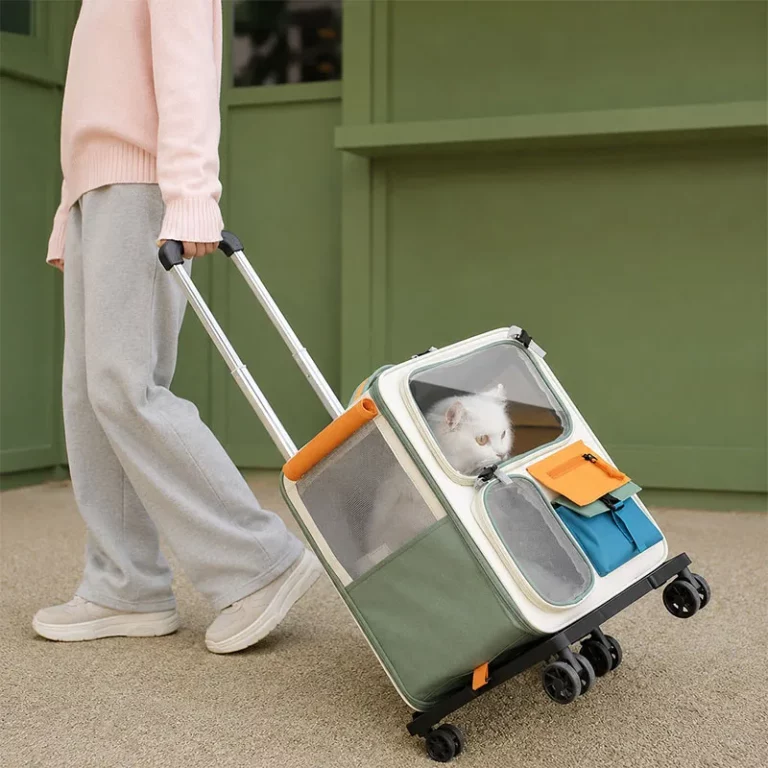
Rolling carrier
A rolling pet carrier can reduce carrying effort in terminals or large transport hubs.
Search data also shows interest in pet carrier with wheels, pet travel carrier with wheels, and wheeled dog carrier products, making this an attractive adjacent category for travel-focused retailers.
Expandable carrier
An expandable model gives additional resting room when stationary.
It works well for owners who want a flexible travel pet setup but still need a compact travel form.
Cat carrier bag
A fabric cat carrier bag may appeal to urban cat owners who prioritize lightweight movement.
Large travel crate
A large pet needs a properly sized rigid enclosure rather than being forced into a small consumer carrier.
Retail assortment example
| Product Type |
Main Search Intent |
Retail Position |
| Hard-shell pet carrier |
Air and general travel |
Core SKU |
| Soft-sided carrier |
In-cabin and short trips |
Lightweight option |
| Pet carrier with wheels |
Airport mobility |
Premium travel |
| Backpack carrier |
Urban travel |
Lifestyle product |
| Expandable carrier |
Comfort during waiting |
Premium feature |
| Cat travel carrier |
Cat-focused customer |
Species-specific |
| Dog carrier |
Small dog travel |
Dog category |
| Large travel crate |
Larger animals |
Specialty transport |
This approach helps stores capture both general best pet carriers searches and more specific use cases.
How Can OEM and Private-Label Customization Improve a Pet Carrier Line?
A generic carrier competes mainly on price.
A well-planned private-label range can compete through better colors, clearer size charts, stronger packaging, improved instructions, and useful accessories.
PetNivo Tech supports global retailers, distributors, importers, e-commerce sellers, and private-label brands with pet product sourcing and customization.
Possible options for carrier projects may include:
- Custom shell colors
- Pantone color matching
- Printed or applied logos
- Retail carton design
- Private-label stickers
- Instruction manuals
- Size labels
- Travel warning cards
- Replacement fastener packs
- Feeding accessories
- Removable pads
- Optional wheel systems
- Barcode and shipping marks
The available customization depends on the exact carrier and manufacturing partner.
Illustrative private-label carrier project
An importer wants to launch three travel sizes.
The first proposal uses the same packaging concept for every size. The large carrier, however, creates excessive dimensional freight cost.
The sourcing team changes the program:
- Uses nestable upper and lower shells.
- Ships the metal door inside the body.
- Packs handles and bolts in labeled bags.
- Adds a QR-linked assembly guide.
- Prints internal and external dimensions.
- Adds an airline-policy disclaimer.
- Creates different carton plans for each size.
This improves shipping efficiency while making the final product easier for consumers to understand.
Why Source Pet Travel Products Through PetNivo Tech?
The pet travel category involves more than one plastic box.
Retailers may need:
- Hard-shell carriers
- Soft-sided carriers
- Wheeled carriers
- Travel bags
- Pet backpacks
- Car seat covers
- Portable feeders
- Water bottles
- Pet ID tags
- Travel crates
- Foldable pet beds
PetNivo Tech helps B2B customers bring these products together through one sourcing and coordination workflow.
Our support may include:
- Product selection
- Supplier coordination
- Sample comparison
- Material review
- Private-label customization
- Packaging development
- Production monitoring
- Quality inspection
- Export coordination
For an importer, this reduces the need to manage separate communications for every product.
For a retailer, it creates the possibility of a complete pet travel collection instead of a single SKU.
For an e-commerce seller, clearer product specifications can also reduce one common problem: customers ordering a carrier without checking the pet or airline dimensions first.
The goal is simple.
Help the buyer choose the right pet carrier before travel.
That creates a better customer experience and a stronger product line.
Frequently Asked Questions
Is a hard-shell pet carrier airline approved?
No carrier is universally approved by every airline. IATA does not certify individual commercial dog or cat carriers. Travelers should check the carrier dimensions, construction, pet size, airline policy, aircraft, route, and destination requirements before each trip.
Is a hard-shell carrier better than a soft-sided carrier for flying?
It depends on how the animal will travel. Soft carriers may offer more flexibility under an airline seat, while rigid plastic carriers provide more structural protection and are commonly used for other air-transport arrangements. Always confirm the airline’s current requirements.
Can a cat travel in a plastic pet carrier?
Yes, when the box is correctly sized and suitable for the intended journey. A cat should be able to stand, sit, turn around, and lie naturally inside its cat travel carrier.
Can a small dog use an in-cabin hard-shell carrier?
Possibly. The carrier must fit the airline’s current cabin-size requirements, and the dog must fit comfortably inside. Since rigid shells cannot compress, exact external dimensions are especially important.
Are airline rules the same worldwide?
No. Airline policies, national import rules, health-document requirements, and route restrictions vary. IATA provides global standards, but airlines and governments may impose additional conditions.
Can PetNivo customize plastic pet carriers for private-label brands?
Yes. Depending on the product and order plan, PetNivo can coordinate shell colors, logos, labels, retail packaging, manuals, size markings, accessories, and other private-label requirements.










 September 04, 2026