PetNivo Tech Global Export Team | International Trade & Export Team | Published September 2026
MOQs across PetNivo’s catalog run from 5 units (bird cages) to 200 pieces (some feeding products), driven mainly by customization scope. Samples typically take 7-14 days; mass production runs 30-45 days after sample approval. FOB, CIF and DDP support is available depending on how much logistics a distributor wants to manage directly.
The MOQ Range Isn’t Random — It’s a Customization Signal
A distributor scanning supplier pages for “wholesale pet supplies” runs into MOQs anywhere from 5 units to several thousand, sometimes on what looks like the same product category. That spread isn’t inconsistent pricing. It’s a direct readout of how much customization a given order requires.
An unbranded, stock-configuration item — standard color, no logo, existing packaging — can clear a low MOQ because it doesn’t trigger a new production setup. A private-label version with a custom color box, printed logo, and material substitution requires retooling, new packaging runs, and separate QC criteria, so the supplier needs volume to make that setup worthwhile. Two listings for the “same” bowl can carry MOQs of 50 and 3,000 pieces for exactly this reason, and neither number is wrong — they’re answering different questions.

MOQ by Category: What’s Actually Published
| Product Category |
Representative MOQ |
Example SKU |
| Bird cages |
5 units |
Premium Large Birds Cage |
| Dog exercise equipment |
10 units |
Electric Dog Running Machine |
| Dog crates |
20 units |
Metal Tube Dog Crate with Shelf |
| Cat furniture (trees, wheels) |
20 units |
Multilevel Plush Cat Tree, Wooden Cat Running Wheel |
| Litter boxes |
20 pcs |
Extra Large Stainless Steel Cat Litter Box |
| Grooming equipment |
20 units |
Automatic Pet Hair Dryer Box |
| Pet carriers |
20 units |
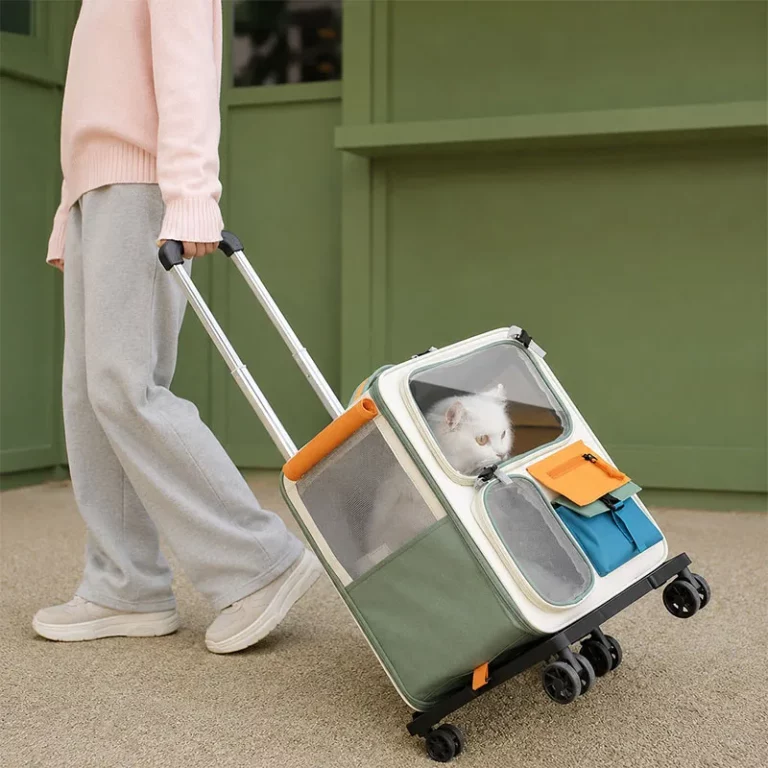
Pet Carrier with Wheels |
| Feeding products (general) |
50-200 pcs |
Varies by model and customization |
| Water bottles |
50 pcs |
2-in-1 Portable Dog Water Bottle |
| Cat scratchers |
50 pcs |
Natural L-Shaped Cat Scratcher |
| Bird toys |
50 pcs |
Wooden Wind Chime Bird Toy |
| Car seat covers |
100 pcs |
Waterproof Non-Slide Pet Car Seat Cover |
Carton dimensions and packing count per carton aren’t disclosed at the category level — request these per SKU before modeling freight cost, since they don’t scale predictably with MOQ.
Sample Timeline: 7-14 Days
Sample production is generally stated at 7-14 days. That window covers producing a physical unit against your spec, not designing one from scratch — if you’re requesting a color or material change from an existing model, expect the shorter end; a new mold or structural change pushes toward the longer end or beyond it, and that’s a question worth asking directly rather than assuming.
Mass Production: 30-45 Days After Sample Approval
Once a sample is approved, mass production is generally stated at 30-45 days, with the range depending on customization complexity. This clock starts at approval, not at order placement — a delayed sample-approval decision on the distributor’s side pushes the entire timeline back by the same number of days, which matters when a regional distributor is planning shelf dates against a specific retail season.
FOB, CIF, DDP: Where the Responsibility Line Actually Sits
These three terms get used loosely in casual sourcing conversations, but they mark distinct points where cost and risk transfer from supplier to buyer:
FOB (Free on Board) — the supplier’s responsibility ends once goods are loaded onto the vessel at the origin port. The distributor arranges and pays for ocean freight, insurance, customs clearance, and inland delivery from the destination port. This gives the distributor the most control over freight-forwarder selection and cost, at the cost of managing more logistics steps directly.
CIF (Cost, Insurance, Freight) — the supplier arranges and pays for ocean freight and marine insurance to the destination port. The distributor still handles customs clearance and inland transport from that port onward. This shifts the freight-booking workload off the distributor’s team but reduces their leverage over carrier choice and routing.
DDP (Delivered Duty Paid) — the supplier handles everything through customs clearance and duty payment, delivering to the distributor’s specified location. This is the lowest-effort option for the buyer but typically carries the highest quoted unit price, since the supplier is pricing in customs risk and duty variability.
PetNivo states support for all three arrangements. Which one makes sense depends less on unit price and more on whether the distributor already has an established customs broker and freight forwarder relationship at the destination — a first-time importer with no existing logistics infrastructure often comes out ahead on DDP despite the higher sticker price, once broker fees and customs delays are priced in.
Mixed-Container and Flexible-Order Cooperation
PetNivo’s published capabilities include mixed-product and flexible-order cooperation — combining multiple SKUs or categories within a single order or container rather than requiring a full container of one product. For a regional distributor testing several categories before committing volume to any single one, this matters more than the headline MOQ on any individual item: a mixed order can let a distributor meet a supplier’s aggregate minimum while keeping per-SKU quantities low enough to test market response before reordering.

What OEM and Private Label Actually Include
Customization options span logo branding, silk-screen printing, laser engraving, woven labels, custom color boxes, kraft packaging, hang tags, instruction manuals, and color or material substitution, alongside broader product-development and prototyping support. None of this is included by default in the base MOQ and reference price for a stock item — each customization element typically has its own minimum and lead-time impact, which is exactly why “the MOQ” isn’t a single fixed number across a product line.
Quality Control Before Shipment
Quality control coverage includes product appearance, materials, workmanship, packaging, and order accuracy, with category-specific checks — material, structural, or electronic-component review — depending on the product type. What isn’t disclosed is the specific inspection standard applied (AQL level, sampling ratio) or whether third-party inspection is available as an add-on. Distributors placing a first order should confirm inspection standard and reporting format in writing before production begins, not after goods are already packed.
The Edge Case: When Low MOQ and Full Customization Don’t Coexist
A distributor request that comes up often — and that a supplier page rarely addresses directly — is asking for a low unit count alongside full private-label customization: custom color, printed logo, custom box, all at a 50-unit order. That combination often isn’t available in practice, because customization setup cost gets amortized across the order quantity, and 50 units usually isn’t enough volume to make custom tooling and packaging runs commercially viable for the supplier. Where a distributor genuinely needs a small trial batch, the more workable path is usually stock configuration with minimal customization (a single logo application, no packaging change) rather than full private-label at MOQ floor — a trade-off worth raising directly instead of assuming full customization scales down freely.

FAQ
Q: Why does MOQ vary so much between products that seem similar?
A: Customization scope, not product complexity, drives most of the variance. A stock-configuration item clears a lower MOQ than the same item with custom branding, color, or packaging.
Q: How long from order to delivery should I plan for?
A: Budget 7-14 days for sample production, then 30-45 days for mass production after you approve the sample — plus transit time, which depends on the shipping term and destination. The mass-production clock doesn’t start until sample approval, so a slow approval decision extends your total timeline.
Q: What’s the real difference between FOB and DDP for a first-time importer?
A: FOB puts more logistics responsibility — and more cost control — in your hands after the goods leave port. DDP shifts customs clearance and duty payment to the supplier at a higher unit price. Without an established customs broker relationship, DDP often works out simpler despite costing more per unit.
Q: Can I combine multiple product categories in one order to meet a minimum?
A: PetNivo states support for mixed-product and flexible-order cooperation, which allows combining SKUs or categories within a single order rather than requiring full-container volume on one item.
Q: Are the reference prices I see on product pages what I’ll actually pay?
A: No — they’re screening figures based on website-listed ranges, not fixed quotations. Final pricing depends on quantity, specification, customization, packaging, and shipping terms.
Q: What quality inspection can I expect before shipment?
A: Coverage includes appearance, materials, workmanship, packaging, and order accuracy, with category-specific checks for structural or electronic components where relevant. Inspection standard and sampling ratio aren’t disclosed by default — request this in writing before production.
Q: Is a 50-unit order realistic if I want full private-label customization?
A: Often not in practice — customization setup costs typically need more volume to amortize. A more workable approach for small trial orders is usually minimal customization (single logo, no packaging change) rather than full private-label at the MOQ floor.







 September 18, 2026