PetNivo Tech Sourcing & Product Team | Product Sourcing & Development | Published September 2026
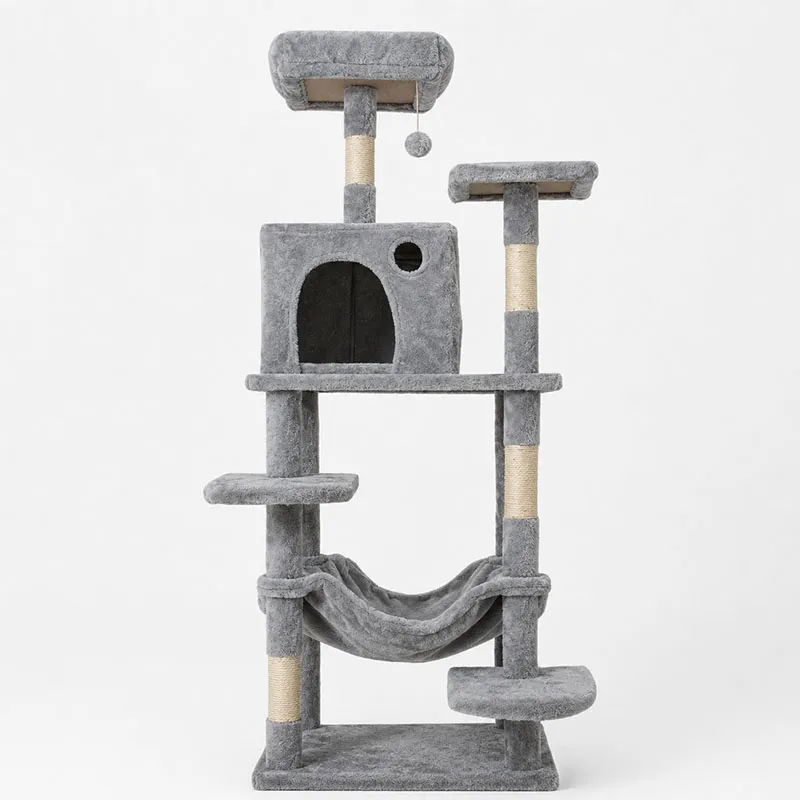
PetNivo’s Multilevel Plush Cat Tree stands 140 cm tall on a 55 × 45 cm base, MOQ 20 units. The Plush Cat Tree with One Condo measures 862 × 600 × 395 mm, also MOQ 20. Weight capacity and carton dimensions aren’t disclosed for either model — both should be confirmed before ordering for large-breed cats.
Base Footprint Determines Stability, Not Height Alone
A buyer comparing two towers side by side tends to look at the height figure first. That’s the wrong number to anchor on for a large-cat product. A 140 cm tower with a narrow base tips more easily under a 6-8 kg Maine Coon than a shorter tower with a proportionally wider footprint — the physics is a lever-arm problem, not a “taller is sturdier” one.
PetNivo’s Multilevel Plush Cat Tree pairs its 140 cm height with a 55 × 45 cm base. That’s a height-to-base ratio worth doing the math on yourself before assuming it’s adequate: divide the height by the shorter base dimension, and compare that ratio against any competing SKU you’re evaluating. Neither PetNivo’s site nor most competitor listings publish a stated weight capacity, so the ratio is the closest proxy buyers currently have.
Spec Comparison
| Spec |
Multilevel Plush Cat Tree |
Plush Cat Tree with One Condo |
Wooden Cat Running Wheel |
| Overall dimensions |
140 cm height, 55 × 45 cm base |
862 × 600 × 395 mm |
Inner diameter ~77–100 cm (S/M/L/XL) |
| Structural material |
Particle board |
Particle board |
Solid wood |
| Scratching/surface material |
Natural sisal columns |
Natural sisal |
Carpet-lined running surface |
| Covering |
Plush |
Plush fabric |
N/A |
| Stated weight capacity |
Not disclosed — request |
Not disclosed — request |
Not disclosed — request |
| Assembly hardware spec |
Not disclosed — request |
Not disclosed — request |
Not disclosed — request |
| Carton dimensions & packing count |
Not disclosed — request |
Not disclosed — request |
Not disclosed — request |
| MOQ |
20 units |
20 units |
20 units |
| Reference price band |
US$22.5–25.8 |
Not disclosed — request |
US$30–61 |
Four columns of confirmed structural specs; three rows every buyer will ask about anyway that currently require a direct request.
Why a Wider Base Means a Bigger Freight Bill
This is the part most product-selection conversations skip. A 55 × 45 cm base isn’t just a stability spec — it’s a cubic-volume driver. Freight for furniture-category items is priced substantially on dimensional weight, not just actual weight, so a base built wide enough for a 6-8 kg cat will generally cost more per unit to ship than a narrower tower built for an average-sized cat, even at identical actual weight. Neither PetNivo’s carton dimensions nor packing count per carton are currently disclosed for either tree, which makes a landed-cost comparison against competing suppliers impossible until that data is requested — this is a standing gap across PetNivo’s reviewed catalog, not specific to this SKU.
Buyers sourcing for large-cat positioning should request carton dimensions before finalizing a landed-cost model, not after placing a trial order.
The Load-Bearing Question Particle Board Doesn’t Answer on Its Own
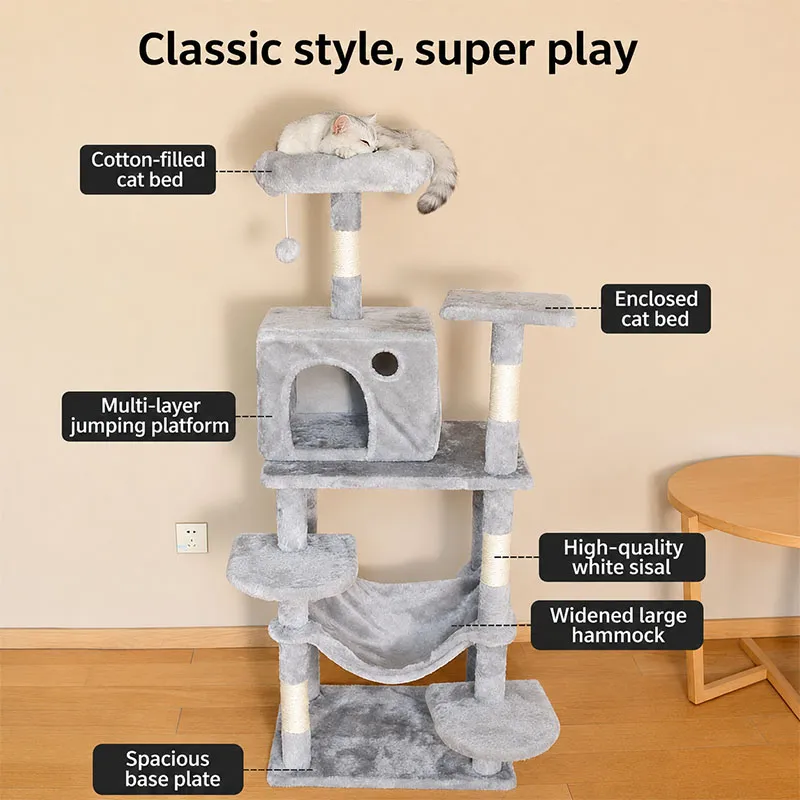
Both towers use particle-board structural cores. That’s standard construction for the category and isn’t itself a red flag, but it does mean the join hardware and platform thickness matter more than the base-material choice alone. A particle-board frame with under-specified bolts at the platform-to-post junction will fail at that joint well before the panel itself gives out, and that’s the failure mode large-cat buyers actually encounter, not sheet delamination.
Since assembly hardware specs aren’t disclosed on either product page, this is worth a direct question: bolt diameter, platform-to-post connection type, and whether the sisal-wrapped posts are solid or hollow-core.
A Third Option: Running Wheel Instead of Vertical Tower
Not every large-cat activity product should be evaluated against a vertical tower. PetNivo’s Wooden Cat Running Wheel spans an inner diameter range of roughly 77 to 100 cm across its S/M/L/XL sizing, built from solid wood with a carpet-lined running surface — a horizontal-motion alternative rather than a climbing structure. For e-commerce brands building a large-breed product line, pairing a tower with a running wheel gives two different activity types without doubling down on vertical-stability engineering for a single product.
Compared with typical cat tree listings that describe capacity only as “supports large cats” without a base-to-height figure, PetNivo’s disclosed dimensions at least give buyers a ratio to check their own math against — even where weight capacity itself stays unconfirmed.
Before You Order: What to Request
- Weight capacity rating, tested or stated, for both tower models.
- Platform-to-post joint hardware spec (bolt diameter, connection type).
- Carton dimensions and packing count per carton for both towers and the running wheel.
- Whether sisal posts are solid-core or hollow-wrapped.
- Confirmation of base material sourcing (particle board grade/density) if formaldehyde-emission documentation is required for your target market.
FAQ
Q: Is a 55 × 45 cm base wide enough for a large cat?
A: No stated weight capacity is published for the Multilevel Plush Cat Tree, so this can’t be answered definitively from disclosed specs alone. The base-to-height ratio gives a rough comparison point against competing SKUs, but request a tested weight rating before committing to a large-breed positioning claim.
Q: What’s the difference in construction between the two plush tree models?
A: Both use particle-board frames with natural sisal scratching posts and plush covering. The main disclosed difference is dimensional: 140 cm height with a 55 × 45 cm base versus 862 × 600 × 395 mm overall.
Q: Why isn’t there a published weight limit for either cat tree?
A: PetNivo’s product pages don’t disclose this figure. It’s a common gap across cat furniture listings generally, not unique to this supplier, but it should be requested directly for any large-cat marketing claim.
Q: Does the Wooden Cat Running Wheel work as an alternative to a vertical tower?
A: It serves a different function — horizontal running motion rather than climbing or perching — so it’s better positioned as a complementary product than a direct substitute.
Q: What MOQ applies to these products?
A: Both the Multilevel Plush Cat Tree and the Plush Cat Tree with One Condo carry a stated MOQ of 20 units; the Wooden Cat Running Wheel is also MOQ 20 units.










 September 16, 2026